
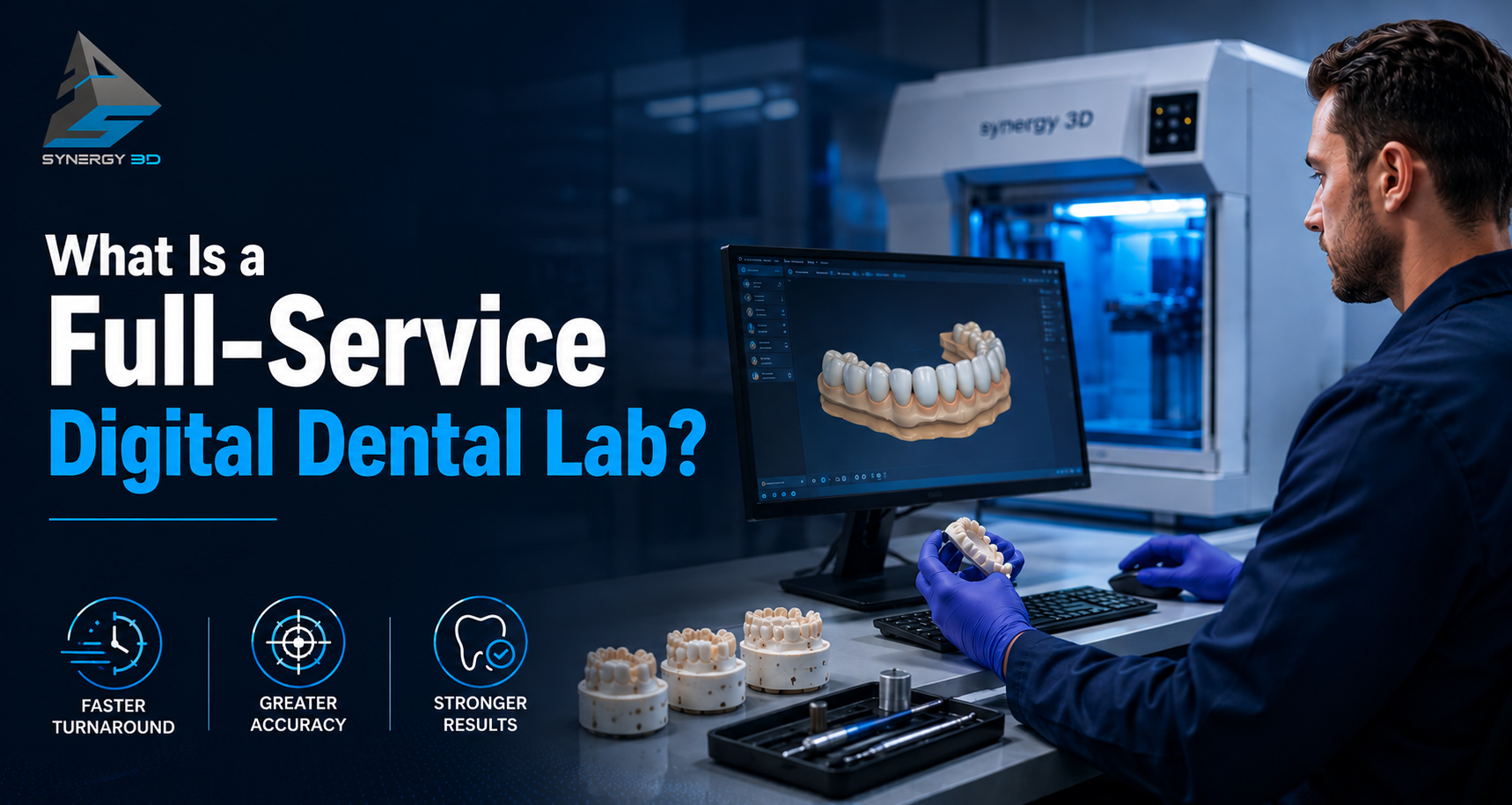
Your patients don’t care about workflows. They care about fit, feel, and how fast they get their crown back. A full-service digital dental lab is the infrastructure that makes all three possible — without you babysitting every step.
But not every lab calling itself “digital” is built the same. Here’s what a truly full-service digital dental lab does, what sets it apart, and how to spot the real ones.
Defining Full-Service Digital Dental Lab
A full-service digital dental lab handles the complete restoration pipeline using digital tools from scan to shipment. That means no stone models, no manual impressions sitting in a bag, no “we’ll get back to you in two weeks.”
The core workflow looks like this:
- You scan the patient using an intraoral scanner
- The STL or .niri file goes to the lab digitally
- The lab designs, mills, or 3D prints the restoration
- You get it back fast — often in five days or fewer
What makes it full-service is the range. Crown and bridge, implant prosthetics, custom abutments, zirconia restorations, removable prosthetics, temporaries — all under one roof, all produced digitally.
What Separates a Digital Lab from a Traditional One
Traditional labs rely heavily on manual fabrication. Wax-ups, casting, hand-layering porcelain. Skilled work, but slow and inconsistent at scale.
A digital dental lab flips that model entirely.
Here’s what changes:
| Factor | Traditional Lab | Digital Dental Lab |
| Impression method | Physical trays | Intraoral scanner files |
| Turnaround time | 10–15 days avg | 3–7 days |
| Consistency | Technician-dependent | CAD/CAM-driven |
| Scalability | Limited | High |
| Error rate | Higher margin for human error | Measurably lower |
The accuracy difference isn’t minor. CAD/CAM-milled restorations routinely hit tolerances under 50 microns. That’s the difference between a crown that seats perfectly and one that needs three adjustment appointments.
The Services a Full-Service Digital Lab Should Actually Offer
If a lab calls itself full-service, hold them to it. Here’s the non-negotiable list:
- Crowns and bridges: single units, multi-unit spans, zirconia, lithium disilicate
- Implant prosthetics: implant crowns, bars, full-arch restorations
- Custom abutments: titanium, zirconia, scan-body compatible designs
- Removable prosthetics: digitally designed full and partial dentures
- Temporaries: milled or printed, delivered fast so patients aren’t waiting
- Intraoral scanner compatibility: should work with iTero, 3Shape TRIOS, Carestream, Planmeca, and others without friction
If a lab is selective about scanner compatibility, that’s a red flag. Your workflow shouldn’t have to conform to their limitations.
Why This Actually Matters for Your Practice
Time is money in dentistry. Every additional lab day is a patient recall appointment, another temporary, another phone call. A good digital dental lab compresses that cycle.
Beyond speed, there’s a consistency argument. Digital production removes technician variability. The third crown of the week is just as precise as the first. That matters when you’re scaling from 10 restorations a month to 100.
It also matters for case acceptance. When patients know they’re getting a precision-milled restoration back in a week, that objection about “coming in again” gets a lot smaller.
How to Evaluate Any Digital Dental Lab Before You Commit
Before sending your first case, ask these five questions:
- What percentage of your restorations are produced digitally? Anything under 80% is a hybrid lab, not a digital one.
- Which intraoral scanners do you accept files from? The answer should be a long list.
- What’s your average turnaround time for a crown? 5–7 business days is the benchmark.
- Do you offer any technical onboarding or support? If the answer is no, you’re on your own.
- What’s your warranty policy on restorations? A confident lab backs their work.
Why Synergy 3D Is Worth Your Attention
If you’re looking for a digital dental lab that operates at the level this article describes, Synergy 3D belongs on your shortlist.
Based in Wappingers Falls, NY, Synergy 3D was built as a digital-first dental laboratory from the ground up. About 98% of their restorations are produced digitally — that’s not a marketing number, that’s their actual operating model.
Their catalog covers the full range: crown and bridge, implant prosthetics, zirconia restorations, custom abutments, temporaries, and removable prosthetics. They’re compatible with major intraoral scanner platforms so your existing workflow doesn’t require an overhaul.
What stands out most is their approach to partnership. Synergy 3D doesn’t just receive files and ship boxes. They provide technical training and support to help dental practices transition confidently into digital workflows. That’s rare from a lab, and it’s the difference between a vendor and a genuine growth partner.
Turnaround is typically five days or fewer for digital cases. Fast enough to keep patients happy. Consistent enough to build your reputation on.
Learn more at synergy3d.net
Summary
A full-service digital dental lab isn’t just a vendor. It’s the backbone of a faster, more consistent, more profitable restorative practice. The switch from analog to digital workflows isn’t a question of “if” anymore. It’s already happening across the industry.
The only question is whether your lab is keeping up, or holding you back.
