
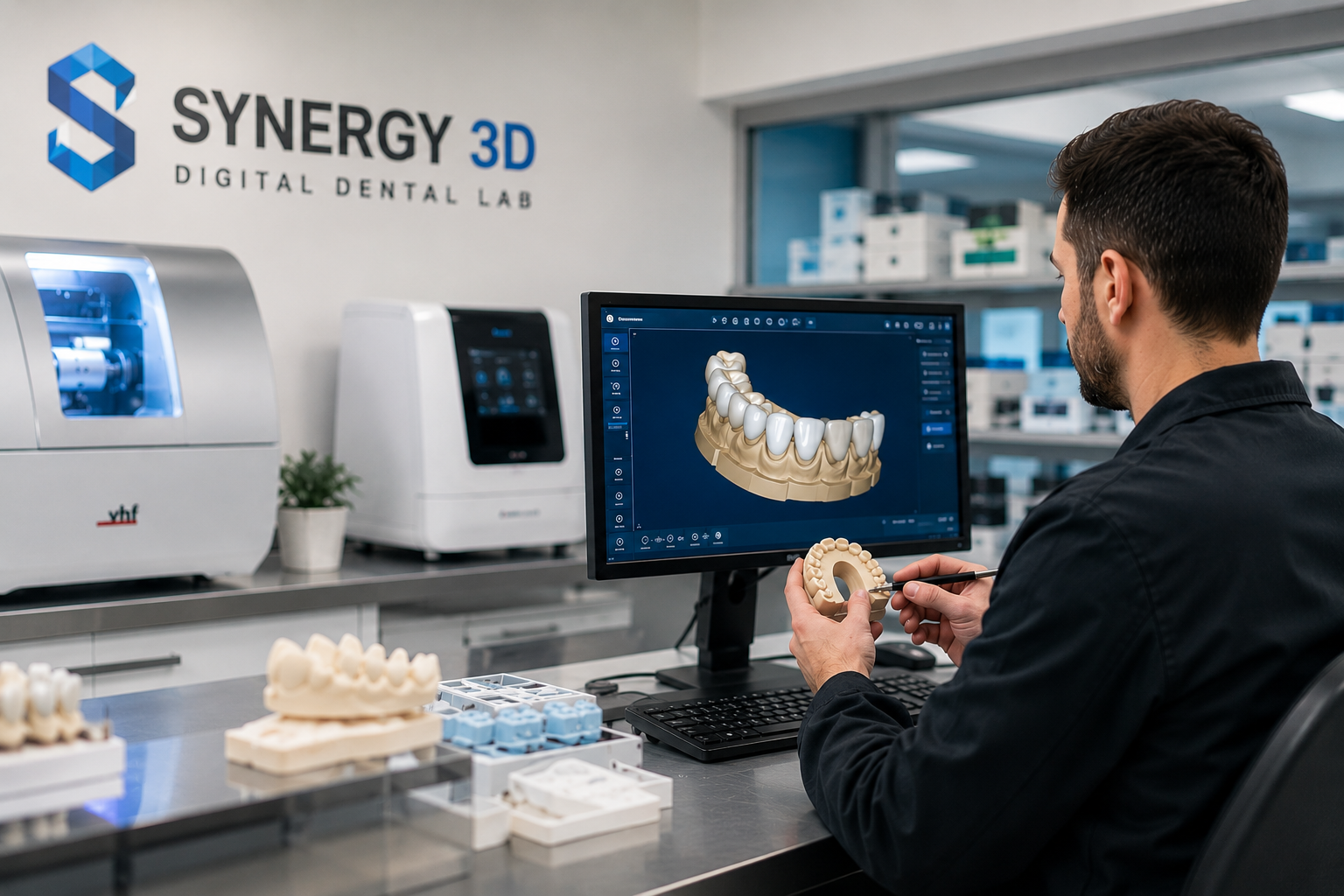
The dentists switching to a full-service digital dental lab aren’t chasing trends. They’re solving real, expensive problems like
- Slow turnaround.
- Inconsistent fit.
- Patients who don’t come back for the second appointment.
Traditional labs built their reputation on skilled hands. That still matters. But skilled hands working inside a 12-day turnaround cycle and an analog impression workflow? That’s a business constraint dressed up as a process.
Something had to give. And across practices of every size, it’s the same story: “Once a dentist sends their first fully digital case, there isn’t much appetite to go back.”
The Real Reason Behind This Shift?
Speed gets the headline, but it isn’t the whole story.
Yes, a full-service digital dental lab cuts turnaround to five days or fewer for most cases. That alone changes the math on patient scheduling, temporary management, and chair time.
But the stickier reason dentists stay is consistency.
When you mill a crown from a CAD design, the result is repeatably accurate. Not “good for a Monday” accurate. Accurate every time, for every technician, for every case. That kind of predictability changes how a practice builds its reputation. You stop managing variation and start trusting the output.
What “Full-Service Digital Dental Lab” Actually Means (and Why It Matters)
Not every lab waving a digital banner is actually full-service. Some digitized one part of their workflow, maybe the design phase, while the rest is still analog production.
A genuinely full-service digital dental lab handles everything:
- Crowns and bridges: single unit through multi-span, multiple material options
- Implant prosthetics: including full-arch restorations and implant-retained overdentures
- Custom abutments: designed from your scan-body data, not generic stock
- Zirconia restorations: high-translucency, layered, or monolithic
- Removable prosthetics: digitally designed full and partial dentures
- Temporaries: milled or printed, fast enough to keep the patient comfortable while they wait
This translates to you have one lab, one point of contact, and no hunting for a specialist lab for every case type.
The Intraoral Scanner Problem Nobody Talks About
Dentists investing in intraoral scanners like iTero, 3Shape TRIOS, Carestream, and Planmeca often run into a surprisingly frustrating wall: the lab they’ve used for years doesn’t accept their scanner’s native files, or they do but without actually optimizing the workflow for it.
So you’re either converting files manually, re-scanning cases, or going back to physical impressions for complex cases. That defeats the purpose entirely.
A full-service digital lab is scanner-agnostic by design. The workflow adapts to your equipment, not the other way around. That single factor (true scanner compatibility) is quietly one of the biggest reasons practices switch labs.
Comparing Analog Workflow with Full-Service Digital Dental Lab
Here’s where it gets practical:
| Metric | Analog Workflow | Full-Service Digital Lab |
| Average turnaround | 10–15 days | 3–7 days |
| Remake rate | Higher (impression error, manual variation) | Measurably lower |
| Temporaries needed | More frequently | Less often |
| Patient recall appointments | More | Fewer |
| Case documentation | Paper, stone models | Digital archive, retrievable |
Fewer remakes. Fewer recalls. Fewer temporaries that patients complain about. These soft wins drive revenue and reputation.
What the Transition Actually Looks Like
This is where practices hesitate, and honestly, it’s a fair concern. Changing labs mid-practice feels like switching accountants mid-audit. There’s real risk in the handover if the new lab doesn’t support you through it.
The best digital dental labs offer onboarding support—not just “here’s our portal.” Real technical guidance. Someone to call when your scan file isn’t seating right in their design software. Training for your team on how to submit digital cases correctly.
That support layer is what separates labs that dentists evangelize from ones they quietly abandon after three cases.
Why Synergy 3D is Worth the Conversation
Synergy 3D was built as a full-service digital dental lab from day one.
Based out of Wappingers Falls, NY, we run a production model where approximately 98% of restorations are digitally produced. That’s the actual operating reality, not a marketing slide. Their full-service range covers crowns and bridges, implant prosthetics, custom abutments, zirconia restorations, removable prosthetics, and temporaries — all under one roof.
We’re compatible with the major intraoral scanner platforms, so your existing investment doesn’t become a problem. And we take the integration seriously, offering technical support and training to help practices transition without friction.
For dentists who want a lab that operates like a partner, not a vendor, that difference is substantial.
Turnaround averages five days or fewer for digital cases.
Learn more at synergy3d.net
The Bottom Line
Dentists are switching to a full-service digital dental lab because it solves multiple problems like slow turnaround, less consistency, and harder to scale. All these factors affect revenue and reputation when you don’t switch to the modern solution.
The ones who switched early aren’t looking back.
Contact us to discuss your case requirement or directly send the case digitally.
