
Walk into most dental labs a decade ago and you’d find plaster, wax, and a lot of waiting.
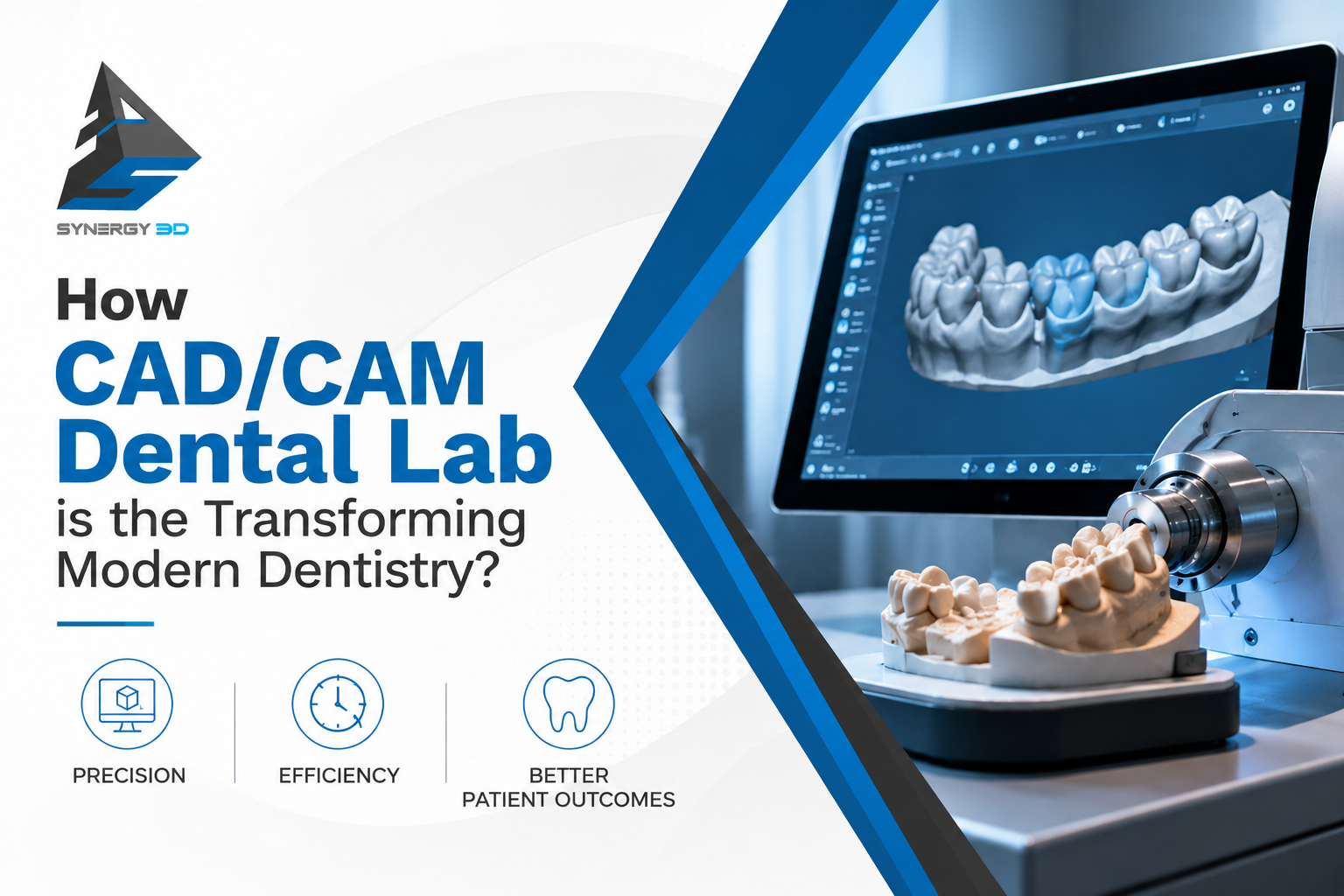
Walk into a serious CAD/CAM dental lab today and you’ll find design software running on dual monitors, milling machines humming through blocks of zirconia, and a digital file library that’s replaced every physical model shelf they used to have. The room looks different. The results are different. And the gap between the two eras keeps widening.
CAD/CAM technology, meaning Computer-Aided Design and Computer-Aided Manufacturing, isn’t a new idea. Manufacturing and aerospace have used it for decades. But dentistry’s adoption of it? That’s a more recent, and genuinely consequential, story.
Why Dentistry Was Ready for CAD/CAM Tech Shift
Dental restorations have always demanded ridiculous precision. You can not just say “wrong” if a crown is even off by half a millimeter, it creates bite issues, occlusal problems, and patient complaints that chase a practice for months.
Traditional fabrication methods could produce excellent results. They could also produce inconsistent ones. The result depended heavily on the technician, the day, the impression quality, the ambient humidity. Too many variables outside anyone’s control.
CAD/CAM pulled precision out of the hands-only scope and into a repeatable, measurable process. That was the shift.
What CAD/CAM Actually Does in a Dental Lab
It’s two technologies working in sequence, and understanding each one separately helps.
CAD, the design phase:
A dental technician (or the software itself, increasingly) builds a 3D digital model of the restoration. This model is designed from the scan data your intraoral scanner captured. The software checks margins, contacts, occlusion, and anatomical shape. Adjustments that used to take skilled wax carving now happen in minutes on screen, and they’re reversible. You can compare versions. You can replicate a design exactly six months later.
CAM, the manufacturing phase:
Once the design is approved, it’s sent to a milling machine or a 3D printer. The machine fabricates the restoration from a block of zirconia, lithium disilicate, PMMA, or another material. Milling tolerances in modern CAD/CAM dental lab environments commonly run below 50 microns. That’s not human-hand territory.
The two together compress a process that used to take two weeks into a few days, with results that hold up to measurement rather than just visual inspection.
Materials That Changed Everything
CAD/CAM tech in dentistry didn’t just speed things up. It unlocked materials that were nearly impossible to fabricate by hand.
High-strength zirconia is the standout. Dense, tooth-colored, virtually fracture-resistant — it’s become the go-to for posterior crowns. But it’s brutally hard to shape manually. A milling machine carves it precisely in under an hour.
Then there’s multi-layered zirconia, designed to mimic the natural gradient of tooth color and translucency. PMMA for digitally milled temporaries. Titanium for custom abutments. These aren’t incremental upgrades. They’re entirely new clinical options made possible by digital manufacturing.
The Intraoral Scanner Connection
A CAD/CAM dental lab only delivers its full potential when the front end works properly. That means the scanner in your operatory, and the file it produces.
When a dentist scans a preparation with an intraoral scanner like iTero, TRIOS, Carestream, and others, the resulting STL or proprietary file goes directly to the lab. No physical model. No courier bag. The lab imports it into their design software and starts work immediately.
This digital handshake between scanner and lab is where speed gets created. A file transmitted at 5 PM can have a design reviewed and queued for milling before the next morning. That’s not possible in any analog workflow. Anywhere.
CAD/CAM Tech in Full-Arch and Implant Cases
If you want to see CAD/CAM’s leverage at full power, look at implant prosthetics.
Full-arch implant restorations, the kind that replace an entire dental arch, used to require extraordinary technician skill and enormous lab time. Today, a CAD/CAM dental lab designs the framework digitally, mills it from titanium or zirconia, and fits prosthetic teeth with precision the old process couldn’t routinely hit.
Custom abutments follow the same logic. Designed from scan-body data, milled to fit the exact implant position and emergence profile of each patient. Stock abutments still exist, but for anything clinical and nuanced, the custom digital route is cleaner.
How Synergy 3D Uses CAD/CAM Technology in Dentistry
Synergy 3D isn’t a traditional lab that added a milling machine to the back room. It’s a CAD/CAM dental lab built from the ground up around digital production.
About 98% of their restorations are produced through digital workflows. That number reflects actual operating architecture and not selective use of technology for certain case types while everything else stays analog.
Their CAD/CAM capabilities span the full restorative range: single-unit crowns, bridges, implant prosthetics, custom abutments, zirconia restorations in multiple formulations, milled temporaries, and removable prosthetics. All from digital files. All from scanner platforms their team has already integrated, so your workflow doesn’t need to be rebuilt to work with theirs.
For practices that have invested in digital scanning and want a lab that can actually match that commitment, the pairing matters. Synergy 3D is built to be that match.
Visit synergy3d.net to learn more.
Where This Technology Is Heading
AI-assisted design is already entering the better CAD/CAM dental lab platforms. Software that proposes restoration anatomy based on adjacent teeth, occlusal data, and case history. Technicians reviewing and refining rather than building from scratch.
Five years from now, a significant portion of design work will be automated. The lab’s value will shift further toward quality control, clinical judgment, and material selection — the parts that still need expertise, not manual execution.
The labs that are digitally fluent now are the ones positioned to absorb that shift without scrambling.
The Honest Take on This Modern Dentistry Shift
CAD/CAM technology didn’t save dentistry from itself. Traditional labs produced beautiful work. But it raised the floor dramatically. Consistent fits, predictable outcomes, faster delivery, better materials are structural ones and not incremental improvements.
For practices serious about the quality they deliver, choosing a CAD/CAM dental lab isn’t an upgrade anymore. It’s just the standard.
