
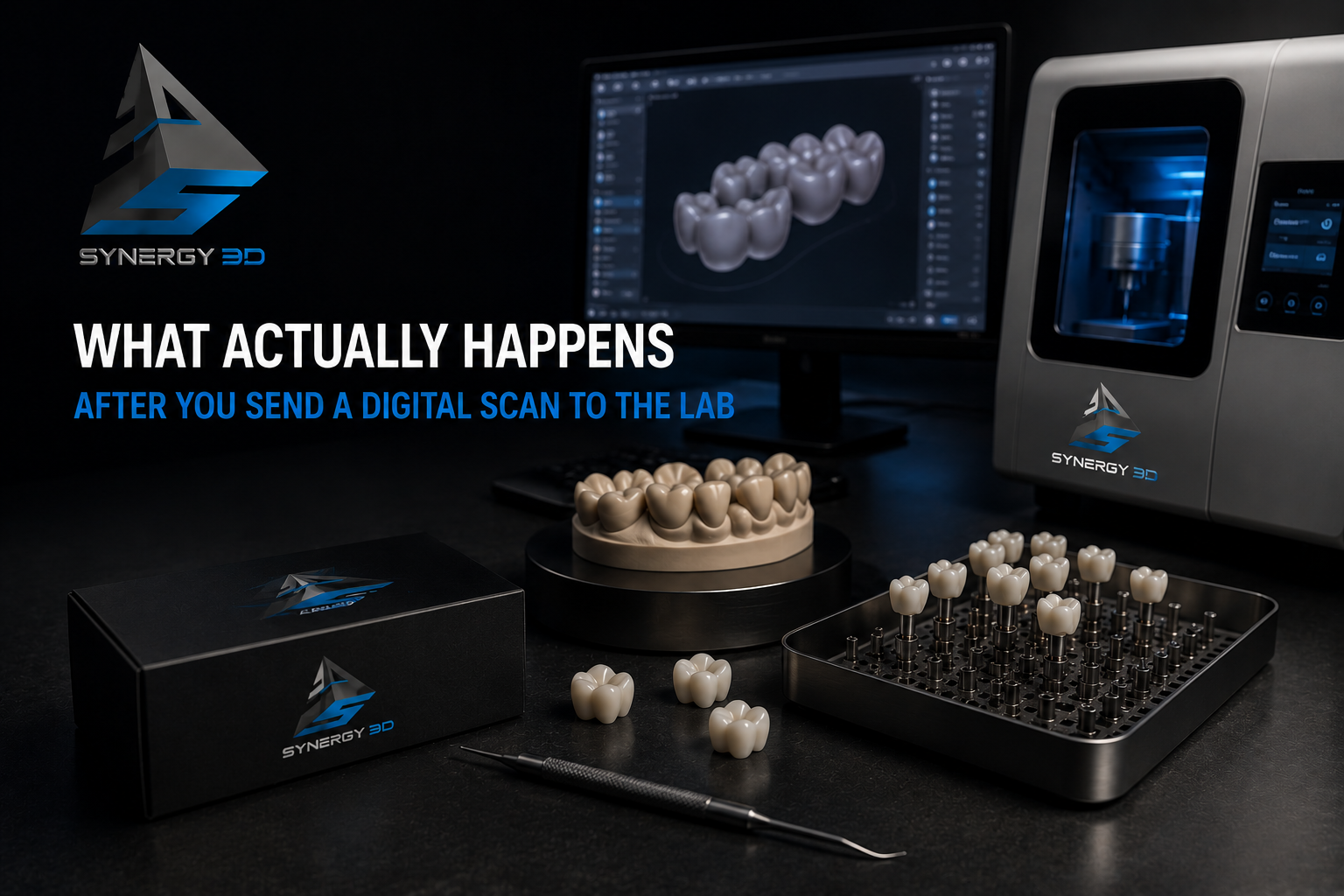
Most dentists know their side of the process. Prep the tooth, take the scan, send it off, wait. What happens between “send” and the restoration arriving at your door? That part is mostly a black box.
It doesn’t have to be. Understanding the actual dental lab workflow, from scan file to finished restoration, makes you a better prescriber, helps you send cleaner cases, and gives you real answers when something doesn’t fit right. The same workflow, we as a modern dental lab, follow for most of the cases that dentists like you send.
Here’s how the whole process works inside a modern digital dental lab.
Step 1: The Case Arrives Digitally
In a full-service digital lab, there’s no courier bag. No stone model sitting in a box. When the dentist finishes scanning the preparation with an intraoral scanner, the file, usually an STL or the scanner’s native format, travels directly to the lab through a secure digital portal.
This step sounds simple. But it’s where most workflow problems get created or avoided.
A clean scan is everything. If the margins are unclear, if soft tissue is crowding the preparation, if the opposing arch wasn’t captured properly. The technician either calls you for a rescan. Or, worse, works around it and produces a restoration that needs multiple adjustments chairside.
Good labs flag margin issues before they design. Great labs train their partner practices to scan in ways that eliminate those calls altogether.
Step 2: Case Review and Prescription Check
Before anyone opens design software, a technician reviews the incoming case.
They check:
- Margin clarity: can the preparation finish line be identified precisely?
- Occlusal clearance: is there adequate space for the restoration material?
- Shade information: is the requested shade documented and realistic for the case?
- Material selection: does the prescription match the clinical situation (posterior load, esthetic zone, etc.)?
This review step is the quality gate that most analog labs skipped. Physical impressions got poured up and sent to design immediately. Digital workflows allow a deliberate pause, a clinical check before any fabrication time is spent.
If something’s off, the lab reaches out, digitally or by phone, before starting. That one call, made early, saves everyone an entire remake cycle.
Step 3: Digital Design (CAD)
This is where the restoration takes shape.
A dental technician imports the scan data into CAD software in programs like Exocad or 3Shape Dental System, which are common in production labs. The software renders the patient’s preparation and surrounding anatomy in three dimensions.
The technician designs the crown, bridge, abutment, or prosthetic using that digital model. They’re working with tools that:
- Automatically propose anatomical contours based on adjacent teeth
- Measure occlusal contacts against the opposing arch
- Allow margin tracing at sub-millimeter precision
- Let them compare design versions side-by-side before finalizing
The output is a design file with precise coordinates for every surface of the restoration.
Some labs are integrating AI-assisted design at this stage. Software that proposes a complete restoration of anatomy in seconds, which the technician then refines. This doesn’t remove the human judgment. It just lets experienced technicians spend that judgment on the parts that actually need it.
Step 4: Manufacturing (CAM)
The design file goes to the machine.
Depending on the material and restoration type, the lab uses one of two production methods:
- Milling: a CNC milling machine carves the restoration from a block of material. Zirconia, lithium disilicate, PMMA for temporaries, and titanium for abutments. Milling tolerances in quality labs run under 50 microns. That’s not a number you can hit with wax and hands.
- 3D Printing: used increasingly for surgical guides, custom trays, denture bases, and some classes of temporaries. Printing has gotten faster and more accurate in the last few years, and it’s becoming a standard production option for the right case types.
- Most restorations are milled. But in a full-service lab, the choice of machine is made based on what the case actually needs: not what equipment the lab happens to have.
Step 5: Post-Processing and Finishing
The restoration comes off the machine looking rough. Zirconia exits the mill in a pre-sintered, chalky state. It has to go into a sintering furnace, a precisely controlled high-temperature cycle, to achieve its final density, strength, and translucency.
After sintering, the technician:
- Checks margins and contacts against the digital model
- Adjusts surface texture and anatomy by hand where needed
- Applies stains and glazes for esthetic cases
- Verifies shade against the prescription
This finishing phase is still deeply manual. The machines get you close. The technician gets you precisely. In digital labs, finishing time is shorter because the milled baseline is already more accurate than what hand fabrication typically starts from.
Step 6: Quality Control
Before anything ships, the restoration goes through inspection.
Quality labs check:
| Checkpoint | What’s Being Verified |
| Margin adaptation | Does the crown seat fully on the die model or printed analog? |
| Contact points | Are proximal contacts correct — not open, not too tight? |
| Occlusal fit | Does the bite relationship match the opposing arch scan? |
| Shade match | Does the final color match the prescription and shade map? |
| Surface integrity | No cracks, pits, or surface defects from milling or sintering? |
Failed QC means the piece gets remade. No exceptions, no “close enough.” The QC step is what separates labs that have low remake rates from labs that have dentists calling their reps every month.
Step 7: Packaging and Delivery
The finished restoration is cleaned, polished, photographed for case records, and packaged. Most digital cases ship within five business days of receiving the scan file.
Some labs offer digital case documentation, such as photos, design files, and shade records archived against the patient case for future reference. For implant cases, especially, that digital archive becomes genuinely valuable when restorations need to be replicated years later.
How Synergy 3D Runs This Workflow
Synergy 3D built this entire dental lab workflow from scratch on a digital foundation. About 98% of their restorations are produced digitally, which means every step described above is how they actually operate, not an aspirational description of selective cases.
Their production covers the full range: crowns, bridges, implant prosthetics, custom abutments, zirconia in multiple formulations, temporaries, and removable prosthetics. They work with major intraoral scanner platforms, so the scan-to-design handoff is smooth regardless of what’s in your operatory.
What sets their workflow apart is the partnership layer built around it. Synergy 3D trains dental practices on how to submit cleaner cases. That means fewer callbacks, fewer rescans, and a faster, more predictable turnaround on every case you send.
Five-day average turnaround for digital cases. Backed by strong warranties. And a team that actually answers when you call.
See the full offering at synergy3d.net
The Workflow Is Only As Good As the Lab Running It
The steps above are standard. Every modern digital lab claims to follow them. But what varies enormously is the precision at each step, the experience of the technicians running design and finishing, and the accountability when something goes wrong.
The dental lab workflow is straightforward. The discipline to execute it consistently is the differentiator. And it’s worth knowing which side of that line your current lab sits on.
