An implant restoration involves more than selecting a crown. The abutment connecting the implant to the final restoration also needs careful consideration. A custom zirconia abutment allows the restorative team to plan this connection around the requirements of an individual case rather than relying solely on a standard component.
For dentists restoring implants, the decision involves several factors. Implant position, available restorative space, soft tissue contours, retention method, and the intended crown design all influence abutment selection.
Understanding these details helps clinicians coordinate the restorative plan with their dental laboratory.
What Is a Custom Zirconia Abutment?
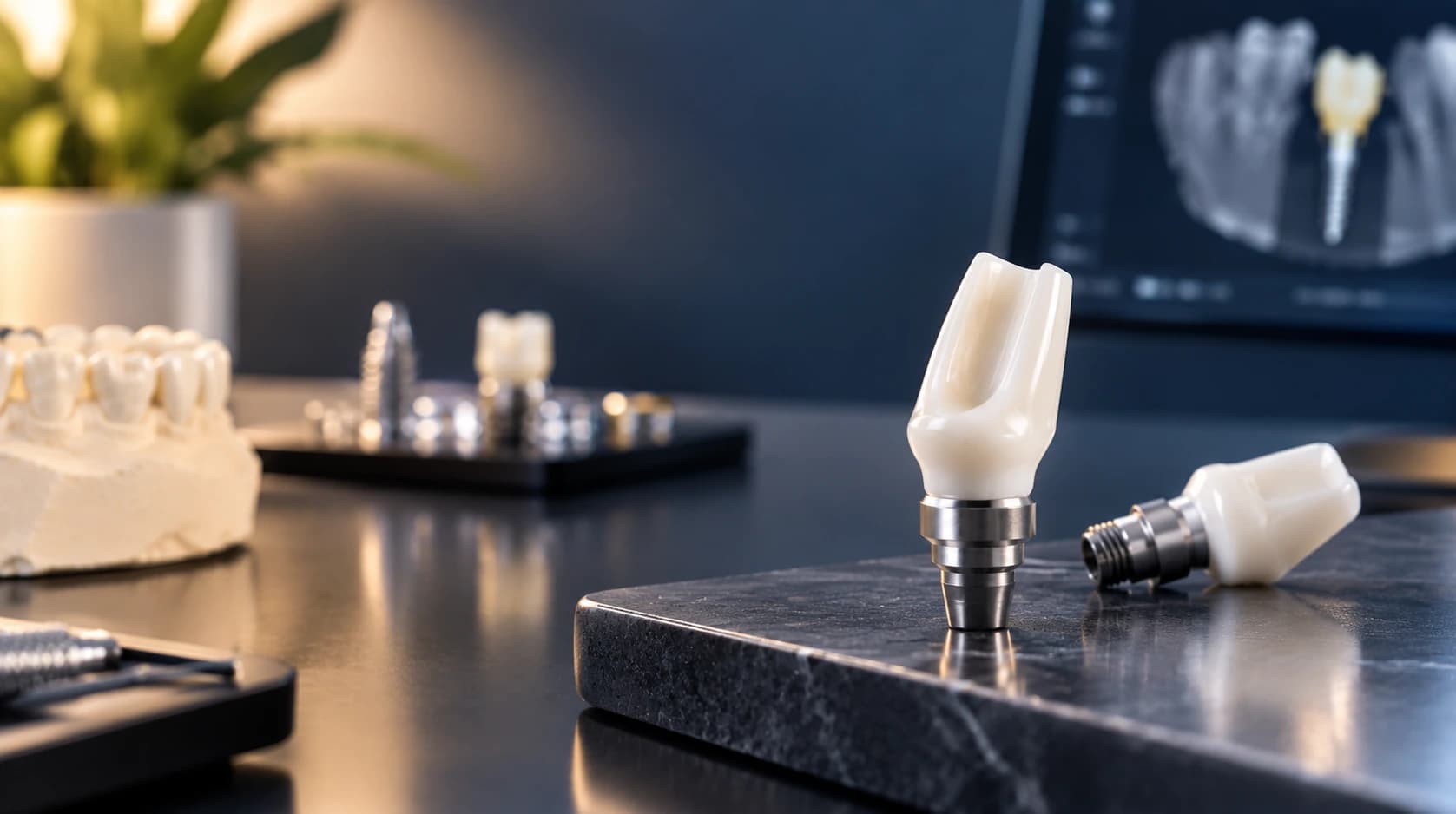
An implant abutment connects the implant fixture to the restoration it supports. Its design influences how the crown sits in relation to the implant and surrounding tissues.
A custom zirconia abutment is individually designed using zirconia, a ceramic material valued for its tooth-colored appearance. Some designs combine a zirconia component with a titanium base, bringing together zirconia's esthetic qualities and a titanium implant connection.
The appropriate design depends on the implant system, the restoration, and the clinical requirements. Not every case calls for the same abutment configuration.
Why Does Case-Specific Design Matter?
Implants do not occupy identical positions in every patient's mouth. Their depth, angulation, and relationship to the surrounding teeth and tissues can vary. These differences influence how the final crown needs to emerge from the gumline.
Implant Position and Restorative Space
The implant's three-dimensional position affects the space available for the abutment and crown. If the restorative components do not account for that position, the intended crown contour may become difficult to achieve.
The restorative team should therefore evaluate implant position alongside the planned crown rather than treat the abutment as an isolated component.
Emergence Profile and Tissue Contours
The emergence profile describes how the restoration transitions from the implant area through the surrounding soft tissues and into the visible crown.
A custom design can help the team plan this transition around the patient's anatomy. However, the desired contour must remain compatible with the available tissue, implant position, and hygiene requirements. A custom design alone does not guarantee a particular tissue response.
Crown Design and Retention
The abutment must work with the final restoration. The choice between screw-retained and cement-retained approaches affects the design requirements and the clinical workflow.
For cement-retained restorations, margin accessibility and cement removal require particular attention. Screw-retained restorations have different access and component requirements. The dentist should determine the intended approach before the laboratory finalizes the design.
What Information Should Dentists Share With the Laboratory?
Clear case information helps the dental laboratory understand the intended restoration before design and manufacturing begin.
Useful information may include:
- The implant system and connection details
- The implant's position and angulation
- Appropriate digital scans or impressions
- The planned crown design and restorative space
- The preferred retention method
- Shade and esthetic requirements
- Any specific concerns involving tissue contours or occlusion
The exact records required depend on the case and the laboratory's workflow. Dentists should confirm that the submitted files and implant components are compatible with the intended design.
When information is incomplete, the laboratory may need clarification before proceeding. Resolving these questions early can help keep the case organized and reduce avoidable delays.
Zirconia or Titanium for a Custom Abutment?
Neither material is automatically right for every implant restoration.
Zirconia may be considered when esthetics are an important priority, particularly in visible areas where the color of underlying components could affect the final appearance. Titanium remains a well-established option, with material and design choices depending on the implant system and clinical requirements.
The decision should also account for implant location, mechanical demands, available space, connection design, and the evidence supporting the proposed configuration. Zirconia abutments require appropriate design and handling, and they should not be treated as interchangeable with titanium in every indication.
The dentist should select the approach based on the complete clinical picture rather than material preference alone.
How Digital Workflows Support Custom Abutment Design
Digital workflows can help connect the clinical records, abutment design, and planned restoration. CAD software allows the laboratory team to work with digital case information and evaluate the relationship between components before manufacturing.
However, digital design is only one part of the process. Accurate source records, compatible implant connections, appropriate material selection, and technical review remain essential.
At Synergy3D, dentists can explore zirconia hybrid custom abutments that combine zirconia aesthetics with a titanium base. The laboratory's implant solutions can be reviewed on the Synergy3D services page to determine whether a particular option fits the requirements of a case.
Planning the Abutment Around the Restoration
A custom zirconia abutment should be considered within the complete implant restoration plan. Implant position, tissue contours, crown design, retention method, and material selection all need to work together.
For dentists and laboratory teams, clear communication before fabrication helps align the technical design with the intended clinical result. By evaluating these factors together, the restorative team can make a more informed decision about whether a custom zirconia abutment is suitable for the case.