When dentists search for e.max dental lab services , they are usually looking for more than a material.
They are looking for a laboratory that understands where lithium disilicate fits into the case, how it should be designed, and how to turn a digital prescription into a finished restoration.
That distinction matters.
Because e.max is not simply one type of crown.
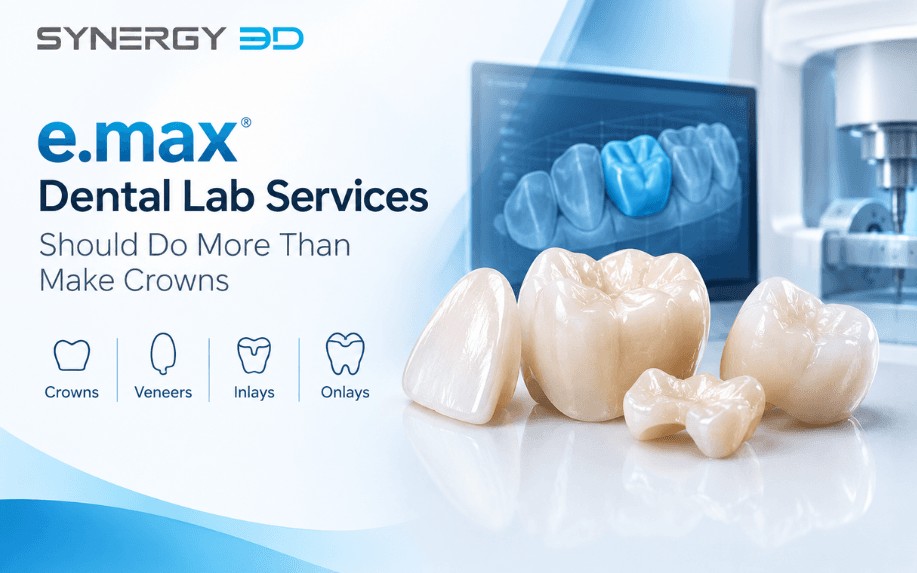
It is a restorative system that can support several different clinical applications, including veneers, crowns, inlays, and onlays. Synergy3D offers e.max restorations for both anterior and posterior cases using IPS e.max CAD.
One Material. Different Restorative Jobs
The same material can serve very different purposes.
An anterior veneer has different requirements from a posterior crown. An inlay does not have the same design considerations as an onlay.
That means a good laboratory cannot approach every e.max case the same way.
The restoration needs to be designed around the tooth, the preparation, the available space, the occlusion, and the clinical objective.
For example, an anterior case may place greater emphasis on translucency and characterization. A posterior restoration may require greater attention to functional anatomy and occlusal contacts.
The material stays within the e.max family.
The laboratory approach changes with the case.
What Should You Expect From an e.max Dental Lab?
The first thing to look for is range .
A laboratory offering e.max should be able to support more than one restoration type.
Synergy3D's e.max service includes veneers, crowns, inlays, and onlays. Its restorations are available in high-translucency options and can be stain and glaze characterized by technicians.
The second thing is design control .
e.max restorations are not successful simply because the laboratory has access to the material. The restoration still needs accurate margins, appropriate anatomy, proper contacts, and a design that matches the clinical prescription.
That is where the laboratory's digital workflow becomes important.
Digital From Your Scan to the Finished Restoration
A digital workflow can remove unnecessary steps between the practice and the laboratory.
Synergy3D accepts scans from major platforms including iTero, 3Shape, Medit, Carestream, Dexis, Sirona, and Planmeca. Dentists can upload their digital case directly through the laboratory's portal.
From there, the case moves into CAD/CAM design and production.
Synergy3D's restoration menu states that its products are milled in-house in New York using FDA-cleared materials. Its e.max restorations are produced through both pressable and CAD/CAM workflows , depending on the case.
This creates a more direct path from the scan you send to the restoration you receive.
The Technician Still Matters
Digital dentistry does not mean the technician disappears.
In fact, the opposite can be true.
A good digital workflow gives the technician better information to work with. The technician still needs to understand anatomy, contacts, occlusion, material limitations, and esthetic goals.
Synergy3D says its technicians are selected for their experience and expertise and are available to help practices with scanner questions and training.
That support becomes especially useful when a case does not fit a routine prescription.
What Makes e.max Different From a Generic Ceramic Service?
The laboratory should understand the material instead of simply producing it.
Synergy3D lists IPS e.max with a flexural strength of at least 400 MPa and positions it for veneers, crowns, inlays, and onlays requiring natural-looking translucency.
That range is one reason case selection matters.
Not every tooth needs the same level of translucency. Not every restoration needs the same design. And not every clinical situation should be approached with the same material option.
The laboratory should be able to work from the clinical information you provide and translate it into an appropriate design.
A Better e.max Workflow Starts With the Prescription
The best e.max dental lab services do not begin when the lab receives the scan.
They begin when the dentist decides what the restoration needs to accomplish.
A complete prescription should communicate the restoration type, shade, preparation information, opposing arch, occlusion, and any esthetic references that could help the technician.
Photographs can also be valuable for anterior cases.
The more complete the case information, the less the technician has to guess.
Why Synergy3D for e.max ?
Synergy3D was built around digital dentistry and has produced restorations digitally since its establishment in 2014. The laboratory says approximately 98% of its restoratives are produced digitally.
Its e.max service combines CAD/CAM production, in-house milling, technician oversight, and digital case submission. The laboratory lists a five-business-day turnaround for e.max restorations.
For dentists, that means e.max is not treated as an isolated product.
It is part of a complete laboratory workflow.
The Right e.max Lab Should Make the Case Easier
Choosing e.max dental lab services should not come down to asking whether a laboratory can produce an e.max crown.
Ask what happens before the crown is made.
Can the lab handle veneers, inlays, onlays, and crowns? Can it work with your scanner? Are cases designed and milled in-house? Can you speak with a technician when a case needs discussion?
Those questions tell you much more about the laboratory than a material name ever could.
At Synergy3D, e.max is part of a digital restorative workflow designed to move from scan to design to production with fewer unnecessary steps.
For your next e.max case, send the scan and let the laboratory handle the rest.
c