Turnaround time used to be a geography problem. It isn't anymore.
Ten years ago, choosing a dental lab was partly a logistics decision. The closer the lab, the faster the case. Local labs had a real advantage, not because they were better at making restorations, but because they were easier to get work to and from.
Digital workflows changed the math entirely. A nationwide dental lab operating on a digital-first model can receive your scan file, design the case, mill or print the restoration, and ship it back in less time than a local analog lab used to spend just pouring the stone model.
Location isn't the variable anymore. Infrastructure is.
Why Local Labs Aren't Automatically Faster
Here's the assumption that still costs practices time and money: that working with a nearby lab shortens the cycle.
In a traditional workflow, proximity helped because physical impressions had to travel. If the lab was 20 minutes away, you could drop off the case. The impression got poured. The technician started work the next morning. That two-day head start over a lab two states away added up across a busy production month.
But when your case is a scan file, proximity is irrelevant. The file reaches a nationwide dental lab in seconds. The only thing that determines turnaround from that point is the lab's production capacity, digital workflow efficiency, and case volume management.
A high-throughput nationwide lab with strong digital infrastructure will routinely beat a local analog lab on turnaround, even accounting for return shipping.
What a Nationwide Digital Lab Actually Looks Like Operationally
Not every lab that accepts cases from multiple states qualifies as a genuinely nationwide dental lab in the operational sense. The distinction matters.
A true nationwide operation is built around:
- Digital intake at scale. Secure portals that accept STL files and native scanner formats from all major platforms. Cases arrive at any hour and enter the production queue immediately.
- Centralized high-capacity production. Industrial-grade CAD/CAM equipment running multi-shift operations. Specialty cases don't wait for a specific person to become available.
- Standardized QC protocols. A dedicated QC step with its own checkpoint criteria keeps remake rates low across thousands of cases per month.
- Reliable shipping logistics. Labs that ship hundreds of cases weekly know which methods are actually reliable. Smaller local operations are often improvising.
The Turnaround Breakdown: Where Time Actually Gets Lost
Most dentists assume the lab is the bottleneck. Often it isn't. Here's the actual breakdown of where case days go:
|
Stage |
Analog Workflow |
Digital Nationwide Lab |
|
Case submission |
Day 1 (physical delivery) |
Instant (file upload) |
|
Impression pouring & model prep |
Day 1–2 |
N/A |
|
Design |
Day 2–3 |
Day 1 (same day as receipt) |
|
Production (milling/sintering) |
Day 3–4 |
Day 1–2 |
|
Finishing and QC |
Day 4–5 |
Day 2–3 |
|
Shipping |
Day 5–6 |
Day 3–5 |
|
Delivery |
Day 7–14 |
Day 4–6 |
The analog workflow burns days on logistics and model prep before any real fabrication work begins. A digital nationwide lab starts design the day it receives your scan. The clock runs from file upload, not from when a courier picks up a bag of impressions.
Consistency Across Cases: The Underrated Benefit
Turnaround speed is easy to see. Consistency is what you feel over time.
When you work with a high-volume nationwide dental lab, you're working with standardized production processes. The crown you receive on case 300 is fabricated the same way as case 3. Same milling protocols. Same QC checkpoints. Same shipping standards.
Local labs, particularly smaller operations, have more variance baked in. One technician calls in sick and your case slips by a day. A new hire handles finishing on a case they're still learning. Production capacity shrinks during holidays with no backup system.
Nationwide labs have redundancy built into their model because they have to. Volume demands it. That redundancy benefits every practice that sends cases.
"Will I Get Worse Service From a Lab That Doesn't Know Me?"
This is a fair concern. And the honest answer is: it depends on the lab.
A high-volume nationwide dental lab that runs on transactional systems and doesn't invest in client relationships will feel impersonal. Your case is a number, the portal has no memory, and when something goes wrong you're on hold.
But the better nationwide labs have invested in clinical support structures precisely because they know this is what clients worry about. Dedicated account managers. Technical onboarding for practices transitioning from analog workflows. Responsive remake policies with real humans approving decisions. The size of the lab doesn't determine the quality of the relationship. The culture does.
Ask before you commit: who do I call when something's wrong? If the answer is a generic support email, think twice.
Synergy 3D: Nationwide Reach, Partner-Level Attention
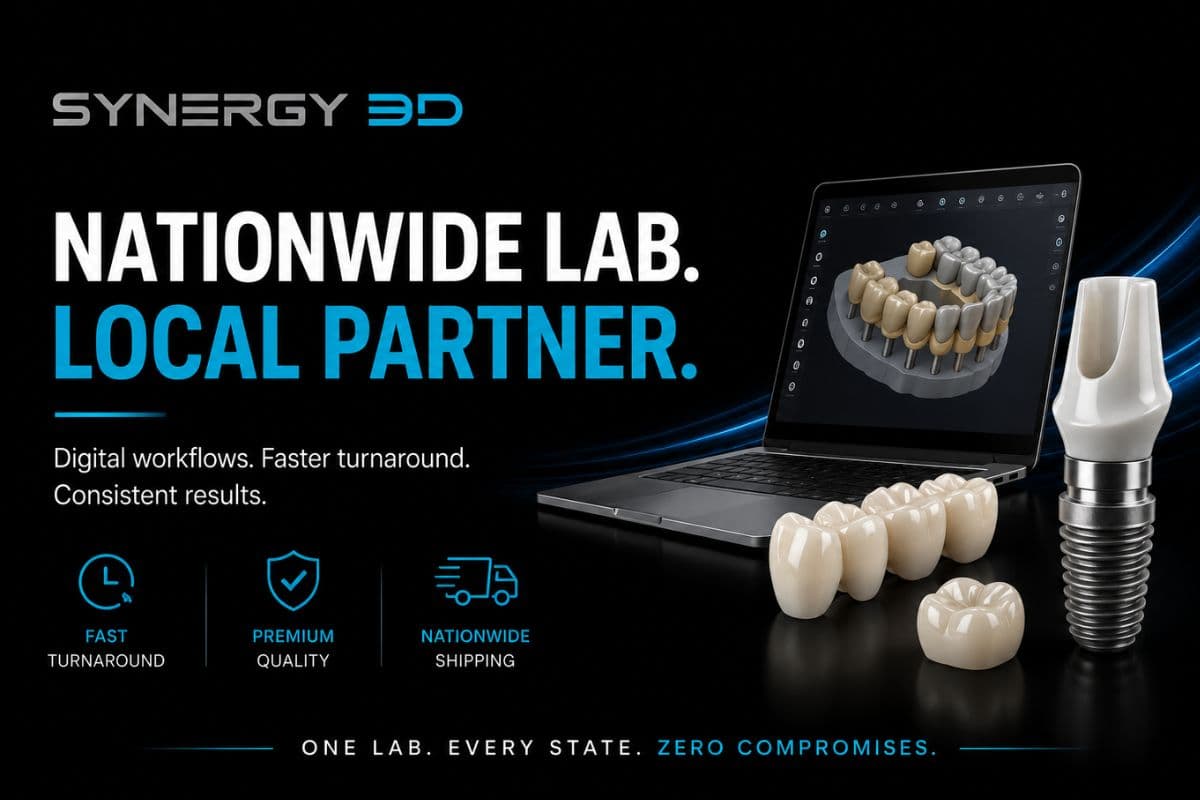
Synergy 3D operates as a nationwide digital dental lab out of Wappingers Falls, New York, and serves practices across the United States through a fully digital workflow.
They're built for exactly the kind of production described above. About 98% of restorations are produced digitally, which means their intake, design, and manufacturing processes are engineered around scan files rather than retrofitted around physical impressions.
Their scanner compatibility covers all major platforms including iTero, 3Shape TRIOS, Carestream, and Planmeca so the submission process is clean regardless of what equipment your practice uses.
What separates them on the "feel like a partner" question is their approach to client support. They offer technical onboarding and training for practices making the transition to digital workflows, and they back their work with clear warranties.
Turnaround on digital cases averages five days or fewer. Their production range covers crowns and bridges, implant prosthetics, custom abutments, zirconia restorations, temporaries, and removable prosthetics.
Learn more at synergy3d.net
The Practices That Benefit Most From Nationwide Labs
Some practice profiles get disproportionate value from a nationwide digital dental lab partnership:
- High-volume restorative practices where consistent, fast turnaround directly affects scheduling capacity
- Implant-heavy practices that need reliable complex-case fabrication beyond what small local labs can produce
- Practices in rural or suburban areas where local lab options are limited and quality varies
- DSOs and group practices that need standardized quality across multiple locations
- Practices transitioning from analog who need a lab that can guide the workflow shift, not just receive files
Frequently Asked Questions
1. Is a nationwide dental lab slower on delivery because of shipping distance?
Not necessarily. Because digital files transmit instantly, nationwide labs often start production faster than local analog labs. Return shipping via overnight or two-day courier typically adds one to two days. For most scheduling workflows, digital nationwide labs return cases as fast or faster than local options.
2. How do I submit cases to a nationwide dental lab?
Most nationwide digital labs use a secure online portal where you upload scan files directly from your intraoral scanner software. The process takes a few minutes per case.
3. What happens if a restoration doesn't fit?
A reputable nationwide dental lab has a clear remake and warranty policy. Ask specifically: what triggers a free remake, what's the process for returning a case, and who approves the decision. The answer tells you a lot about how seriously they take their QC process.
4. Can a nationwide lab handle specialty cases like full-arch implant restorations?
Yes. High-volume nationwide labs typically have more capacity for complex cases because they have dedicated production teams for specialty work. Full-arch frameworks, custom abutments, and implant-retained prosthetics are often better served by labs with the volume to keep those skills sharp.
5. Do I need to change my intraoral scanner to work with a nationwide digital lab?
Not if the lab supports your scanner platform. The better nationwide digital labs accept files from all major scanner brands. Confirm compatibility before your first case, but switching scanners is rarely required.
6. Is quality consistent across all cases with a nationwide lab?
At labs with standardized digital production workflows, yes. The case-to-case consistency of a digital production environment is one of the strongest arguments for the nationwide digital model. Variability typically comes from labs where production still depends on individual technician skill without digital controls in place.
7. How do nationwide dental labs handle urgent cases?
Many offer expedited processing for urgent cases, sometimes with same-day or next-day fabrication queues at an additional fee. Ask your lab what their rush case protocol looks like before you need it.