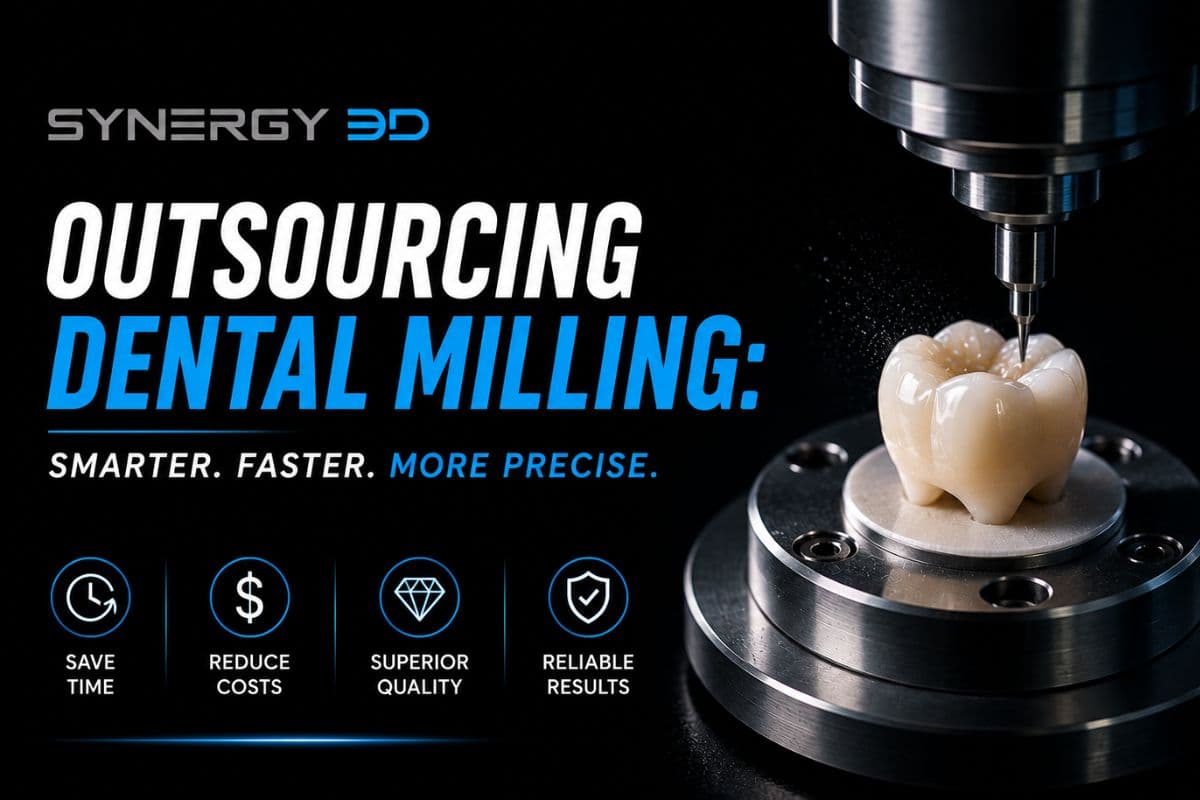
The in-house milling machine sounded like freedom. For most practices, it became a second job.
Buying your own dental milling machine felt like a power move. You thaought that you would get freedom from waiting on labs and shipping delays. Additionally, you woul have full control over production when you have in-house mill.
But six months in, the reality hits you: the machine needs calibration, materials need restocking, someone has to run the software. Suddenly you are burdened with a small manufacturing operation to a clinical practice that was already full.
Therefore, outsourcing dental milling services isn't a compromise, but a helping hand. For the vast majority of practices, it's genuinely the smarter call. Here's why.
Outsourcing Dental Milling Vs In-House Milling: The Math
Let's be direct. A quality chairside milling unit runs between $30,000 and $120,000 upfront. Add materials, maintenance contracts, software licenses, and the time cost of whoever runs it. This number climbs fast.
For high-volume prosthodontic practices doing 40-plus milled restorations per month, that investment can justify itself. For everyone else? You're running a capital-intensive machine at a fraction of its capacity.
That is why, professional dental milling services from a dedicated lab spread that infrastructure cost across hundreds of practices. You pay per case which is very less. Plus the benefit you get are: You don't pay for idle time, software updates, or that Tuesday when the disc block cracked mid-mill.
The Equipment Gap Is Bigger Than Most Dentists Realize
True that chairside mills are competent machines. Industrial-grade 5-axis dental milling systems are something else entirely.
A high-end CAD/CAM lab operates equipment that most dental practices will never own. But the dental lab work with high-precision milling machines, automated tools, and specialized furnaces to create dental restorations. These labs can process materials that aren't available for in-office systems and produce results with very high accuracy. These machines run longer hours with tighter tolerances on materials you can't even purchase in chairside-compatible disc form.
So that means, you're not just outsourcing dental milling for convenience. You're outsourcing access to equipment that produces better outcomes than what's available at chairside.
For an example, milled zirconia from a production-grade 5-axis system fits differently than chairside zirconia. The margins are cleaner. The occlusal morphology is sharper. Patients notice and appreciate the level of precision you've followed.
Outsourcing Dental Milling Work Gives Back the Most Expensive Thing: Time
Every hour your team spends running, monitoring, or troubleshooting a chairside mill is an hour NOT spent on patients.
Dental practices don't run out of money. They run out of time. Chair time is the revenue ceiling. Every minute a licensed clinician or skilled assistant is babysitting a milling cycle is a minute that could've gone toward a patient consultation, treatment planning, or the case after this one.
Outsourced dental milling services convert a fixed overhead burden into a variable cost that scales with your caseload. Busy month? You send more cases. Slow month? You don't carry equipment you're not using. This way, you save time and cost.
Material Range You Can't Match Chairside
Outsourcing unlocks a material library that most practices can't access in-house. Professional labs stock:
- High-strength monolithic zirconia for demanding posterior cases
- Multi-layered translucent zirconia for esthetic anterior work
- Lithium disilicate (e.max equivalents) for veneers and single units
- PMMA and composite for long-term provisionals and full-arch temporaries
- Titanium for custom abutment milling
Your mill at chairside typically handles one or two materials well. A full-service dental milling operation handles all of them and picks the right one for your prescription rather than whatever disc you happen to have loaded.
Speed Isn't What You Think It Is
"In-house means same-day." That's true for very simple, single-unit cases on a good day. But here's what same-day production actually costs: your assistant's attention for a couple of hours, machine time that could've been billable, and a result that may need more chairside adjustment than a lab-produced restoration would.
A top-tier dental milling service returns cases in five days or fewer. For most clinical schedules, that's not a bottleneck. You scheduled the seat appointment when you sent the scan. The restoration arrives before the patient does.
Speed is only an advantage if the result doesn't cost you an extra adjustment appointment.
And that's what Synergy3D delivers.
Synergy 3D: Dental Milling Services Built for Clinical Precision
If you're outsourcing dental milling work, the lab you choose determines whether any of the above actually holds true in practice.
Synergy 3D is a NY-based digital dental laboratory built around high-output, precision milling from the ground up. About 98% of our restorations are digitally produced, which means milling isn't a supplemental service. It's the core of what they we every day.
Our milling capabilities cover the full restorative range:
- Crown and bridge in zirconia, lithium disilicate, and PMMA
- Custom abutments milled from titanium or zirconia
- Implant prosthetics including full-arch framework fabrication
- Temporaries milled for fit and longevity, not just placeholder function
- We're compatible with all major intraoral scanner platforms. Meaning when you send a scan file from your iTero, TRIOS, Carestream, or Planmeca, and our team picks it up without format friction or conversion delays.
Also, turnaround averages five days or fewer for digital cases. Our QC process checks margins, contacts, and occlusion before anything ships. And when practices transition from in-house or analog workflows, Synergy 3D provides technical onboarding support to make that shift clean.
Explore their full capabilities at synergy3d.net
Frequently Asked Questions
-
How do I get started withoutsorcingdental milling work?
First and foremost, find a reliable dental lab partner. They have customer portal that enables you to submit case files digitally, typically in STL or your scanner's native format. Most production labs are compatible with all major intraoral scanner brands so you don't need to convert files manually. Here, Synergy3D is a reliable dental lab based in New York. Over thousands of dentists trust on our milling services. Plus, our 5-day turnaround time is an advantage you'll get. Learn more about Synergy3D here.
-
What types of restorations can a dental milling service produce?
Most professional milling labs produce crowns, bridges, inlays, onlays, veneers, implant crowns, custom abutments, temporaries, and full-arch frameworks. Some labs also produce surgical guides and denture bases using combined milling and printing workflows.
-
Is my cases' quality will improve by outsourcing dental milling service?
For most practices, yes. Professional labs run industrial-grade 5-axis mills with tighter tolerances and a broader material range than chairside equipment. They also have dedicated QC checkpoints before cases ship. Quality varies by lab, so it's worth knowing what their production setup actually looks like before you commit.
-
What's the typical turnaround time for outsourced milling?
Digital cases at quality labs typically return in five to seven business days. Some labs offer expedited timelines for urgent cases.
-
Can I switch from in-house milling to outsourcing without disrupting my practice?
Yes. The transition is smoother than most dentists expect, especially if the lab offers onboarding support. The main adjustment is scheduling: you're planning around a five-day delivery window instead of same-day, which usually means restructuring your seat appointment timing rather than overhauling your clinical workflow.