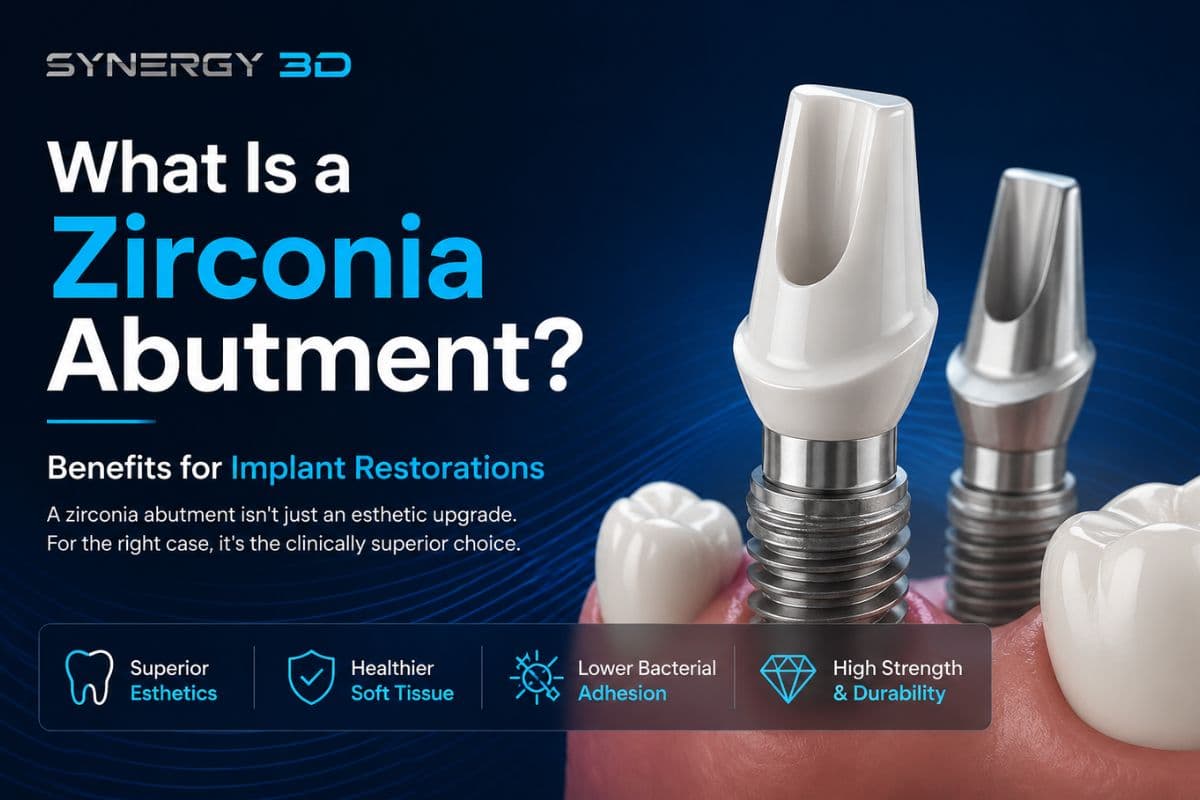
A zirconia abutment isn't just an esthetic upgrade. For the right case, it's the clinically superior choice.
Most dentists learned implant prosthetics when titanium abutments were the default. Titanium was strong, biocompatible, and proven. It worked. For posterior implants loaded with real occlusal force, it still works extremely well.
But the industry learned something important over the years: the material your abutment is made from affects more than just looks. It affects soft tissue response, gingival health, light transmission in the anterior zone, and patient perception of their own smile.
That's where zirconia abutments changed the game.
The Basics: What a Zirconia Abutment Actually Is
An implant restoration has three parts working together. The implant fixture sits in the bone. The crown (or other prosthetic) sits on top and does the visible work. Between them is the abutment. It's the connector, the emergence shaper, and the soft tissue interface all in one component.
A zirconia abutment is simply an abutment fabricated from zirconium dioxide, a high-strength ceramic material, rather than titanium or other metals.
Zirconia has been used in dentistry for years in crown and bridge applications. Its application in abutment fabrication is more recent and has been driven by two things: improvements in CAD/CAM milling precision that allow zirconia to be shaped accurately enough for abutment use, and growing clinical evidence that the material interacts with peri-implant soft tissue differently, and often better, than metal.
Zirconia vs. Titanium Abutments: Where the Real Differences Live
Both materials are biocompatible. Both are clinically viable. But they behave differently in ways that matter.
|
Factor |
Titanium Abutment |
Zirconia Abutment |
|
Strength |
Very high |
High (lower fracture resistance) |
|
Esthetic (anterior) |
Gray show-through possible |
Tooth-colored, no metal shadow |
|
Soft tissue response |
Good |
Excellent in many studies |
|
Bacterial adhesion |
Higher surface adhesion |
Lower adhesion reported |
|
CAD/CAM compatibility |
Standard |
Requires precision milling |
|
Best use case |
Posterior, high-load |
Anterior, thin gingival biotype |
The critical line is the esthetic one. With a titanium abutment in a high esthetic zone, particularly in patients with a thin gingival biotype, you get a gray or dark shadow through the tissue. It's subtle in some cases. In others, it's a visible gray rim at the gingival margin that the patient notices every time they look in the mirror.
Zirconia eliminates that shadow entirely. The tooth-colored material transmits light naturally and doesn't telegraph metal through tissue. In the anterior zone, especially in patients with thin gingiva, this is a clinically meaningful difference.
The Soft Tissue Story Is More Important Than Most People Think
Esthetics is the headline. The soft tissue research is the part worth paying closer attention to.
Several studies comparing zirconia and titanium abutments have found that zirconia surfaces show lower bacterial adhesion. Fewer bacteria colonizing the abutment surface means a healthier peri-implant environment over time. Given that peri-implantitis is one of the leading causes of long-term implant failure, the abutment material that reduces bacterial foothold matters clinically, not just cosmetically.
Beyond bacterial adhesion, some researchers have noted that soft tissue appears to adapt more organically to smooth zirconia surfaces compared to titanium at the gingival interface. The evidence isn't fully settled but the trend is consistent enough that most implant-focused clinicians have incorporated it into their material selection thinking.
The short version: zirconia abutments support healthier tissue architecture around the implant, which helps the restoration look better longer.
Where Zirconia Abutments Excel: The Right Case Profile
Zirconia is the better material choice in specific clinical situations:
- Anterior implants in the esthetic zone. Upper and lower anteriors, especially in patients with normal to thin tissue biotypes. Any case where a gray margin would be visible in the patient's natural smile.
- Patients with thin gingival biotypes. Thin biotypes transmit more light through tissue, which makes metal show-through more likely. Zirconia removes the risk entirely.
- Metal-sensitive patients. Rare but real. Patients with documented sensitivities to metals or who express strong preferences against metal components are good candidates.
- Cases prioritizing long-term tissue health. Even where esthetics isn't the primary driver, the soft tissue data is compelling enough that some clinicians now default to zirconia for all anterior implant abutments.
Where Titanium Still Wins
Be honest about the limits. Zirconia is not the universal right answer.
For posterior implants taking full occlusal load, titanium remains the stronger material. Zirconia can fracture under high cyclic loads, particularly in patients who brux. The clinical literature on posterior zirconia abutment fractures is a real consideration, not a theoretical one.
Narrow-diameter implants also create stress concentration at the abutment connection that favors titanium. And in cases where the emergence profile is extremely angled, titanium offers more machining flexibility without fracture risk.
Use zirconia where it has a clinical advantage. Use titanium where the load demands it. Picking one material for all cases is a simplification that costs patients.
Custom vs. Stock Zirconia Abutments
This distinction matters more than most abutment conversations acknowledge.
Stock zirconia abutments come in standard sizes and shapes. They're faster and cheaper. They also compromise the emergence profile, which is the shape of the abutment as it transitions from the implant platform through the gingiva. That shape determines how the tissue drapes, where the crown margin sits, and ultimately how natural the final result looks.
Custom zirconia abutments are designed from your scan data , using the exact implant position, angulation, and tissue topography of each individual patient. A digital lab mills the abutment to match your patient's anatomy rather than asking the anatomy to conform to a stock shape.
The difference in the final result is visible. Custom emergence profiles support healthier tissue architecture and allow crown margins to be positioned correctly. Stock abutments are a cost-saving compromise that often ends up costing clinical quality.
How Synergy 3D Produces Zirconia Abutments
Synergy 3D produces custom zirconia abutments through a fully digital CAD/CAM workflow designed around the individual case, not a catalog of standard shapes.
Their process starts with your scan file. Using the implant scan body data and surrounding anatomy captured by your intraoral scanner, their team designs the abutment to match the exact emergence, angulation, and margin placement your case requires. The design is milled on industrial-grade CAD/CAM equipment from high-quality zirconia.
This isn't a lab that added abutment fabrication to a crown and bridge operation. Implant prosthetics is a core production category at Synergy 3D , and zirconia abutments are produced with the same precision controls as the rest of their restorative work.
They're compatible with major implant systems and major scanner platforms so submitting these cases doesn't require your team to learn a new protocol. Turnaround on digital implant cases averages five days or fewer. Custom zirconia abutments ship with full case documentation and are backed by their standard warranty policy.
Explore more at synergy3d.net
Frequently Asked Questions
1. Are zirconia abutments as strong as titanium abutments?
In the esthetic zone and for most anterior cases, zirconia abutments are strong enough for reliable long-term clinical performance. They're not as fracture-resistant as titanium under heavy occlusal loads, which is why most clinicians still prefer titanium for posterior implants where bruxism or heavy function is a factor.
2. Do zirconia abutments look better than titanium abutments?
In the anterior zone, yes. Zirconia's tooth-colored material prevents the gray shadow that can show through thin gingival tissue with metal abutments. For patients with thin biotypes or high smile lines, the esthetic difference is significant and visible.
3. Are zirconia abutments better for gum health?
Current research suggests zirconia surfaces accumulate less bacterial biofilm compared to titanium surfaces. That lower bacterial adhesion may contribute to healthier peri-implant tissue over time, though research in this area continues to evolve. It's one of the reasons many implant-focused clinicians are now defaulting to zirconia in appropriate cases.
4. What's the difference between a custom and a stock zirconia abutment?
Stock abutments come in preset sizes and require you to adapt your case to available shapes. Custom abutments are designed from your patient's scan data to match their exact implant position, angulation, and emergence profile. Custom abutments consistently produce better soft tissue contours and more natural-looking final restorations.
5. Can a zirconia abutment fracture?
Yes, though it's uncommon in appropriate case selection. Zirconia is ceramic and has lower fracture toughness than titanium under cyclic heavy loads. For posterior implants or patients with significant bruxism, titanium is generally the safer choice. Proper case selection reduces fracture risk substantially.
6. How do I send a case to a lab for a custom zirconia abutment?
You scan the implant site with a scan body seated in the implant and submit the STL file through your lab's digital portal. The lab uses that scan data to design the custom abutment. Make sure your lab is compatible with your implant system and your scanner platform before submitting the first case.
7. Is a zirconia abutment the right choice for every implant case?
No. Anterior esthetic cases, thin tissue biotypes, and metal-sensitive patients are strong candidates. Posterior cases with heavy occlusal demands are generally better served by titanium. The material choice should follow the clinical situation, not a one-size-fits-all default.
8. How long does a zirconia abutment last?
Clinical data spanning roughly 10 to 15 years shows favorable survival rates in esthetic zone cases with appropriate occlusal loading. Long-term performance depends on case selection, occlusal management, and patient factors including oral hygiene and parafunctional habits.