Not every crown serves the same purpose.
A molar restoration may need to withstand significant occlusal forces, while an anterior crown may place greater emphasis on translucency, shade, and natural appearance. That is why selecting a restorative material should begin with the requirements of the case rather than simply choosing the most popular option.
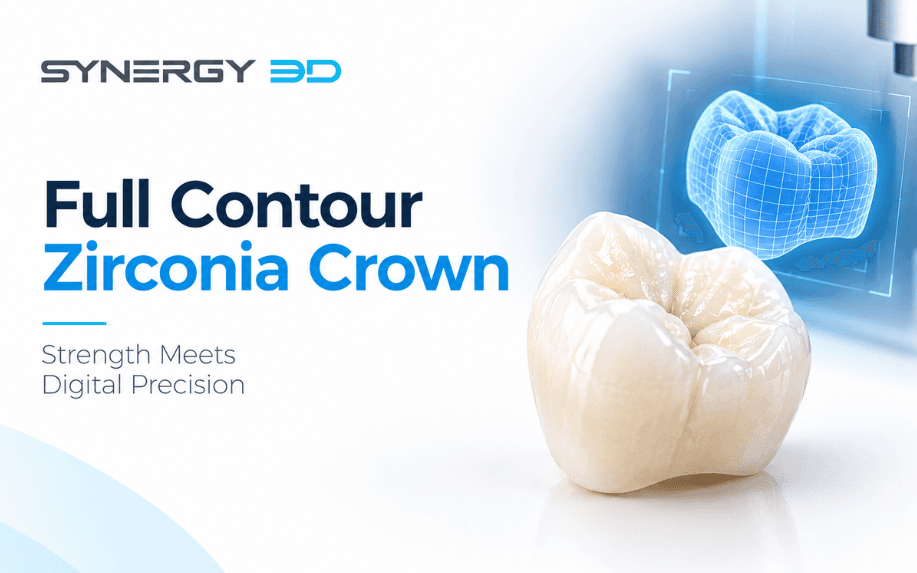
A full-contour zirconia crown offers dentists a combination of strength, digital precision, and streamlined fabrication. Because the restoration is milled from zirconia as a single structure, it does not rely on a separate veneering porcelain layer. For appropriately selected cases, this can provide a practical balance between durability, function, and esthetics.
What Makes Full-Contour Zirconia Different?
Traditional layered restorations typically use a strong framework covered by another ceramic material to create the final appearance.
Full-contour zirconia takes a different approach. The crown is digitally designed to its final anatomy and milled from a solid zirconia blank. The occlusal surface, contours, contacts, and overall anatomy are incorporated into the design before the restoration is manufactured.
This monolithic approach removes the need for a separate veneering layer and can be particularly useful when strength and functional performance are important considerations.
However, that does not mean full-contour zirconia is automatically the right choice for every case. Tooth position, occlusion, restorative space, preparation design, esthetic expectations, and patient-specific factors should all be considered before selecting the material.
The Laboratory Matters as Much as the Material
Choosing zirconia is only the beginning.
The final restoration depends heavily on how that zirconia is designed, milled, finished, and evaluated. Even a high-quality material cannot compensate for inaccurate digital records or a poorly designed restoration.
Contacts need to be carefully controlled. Margins must accurately follow the preparation. Occlusal anatomy needs to work with the patient's existing dentition. Emergence profiles and contours also need to be considered as part of the overall restorative design.
This is where the dental laboratory becomes an important part of the process.
Synergy3D uses a digital-first workflow for its zirconia restorations, with full-contour crowns designed and milled in-house at its New York facility. The laboratory offers different zirconia options, including 5Y-PSZ and 3Y-TZP, allowing the material to be selected according to the requirements of the case.
Strength Does Not Have to Mean Sacrificing Esthetics
Zirconia was once primarily associated with strength.
Today's zirconia materials offer dentists more options.
Higher-translucency zirconia can provide a more natural appearance, while stronger zirconia formulations can be considered for cases where functional demands are greater. This gives clinicians more flexibility when selecting a full-contour zirconia crown .
For example, a posterior restoration may place greater emphasis on strength and occlusal stability. A visible tooth may require greater attention to translucency, shade, surface characterization, and how the restoration interacts visually with adjacent teeth.
The key is not simply choosing the strongest or most translucent material. It is choosing the material and design that make sense for the individual case.
Why Digital Design Makes a Difference
The digital workflow begins long before the zirconia reaches the milling machine.
An intraoral scan can provide the laboratory with detailed information about the preparation, adjacent teeth, opposing dentition, and occlusion. That information can then be used during CAD design to create the restoration around the patient's specific anatomy.
This allows technicians to evaluate important details before production begins.
At Synergy3D, digital design and in-house milling connect these stages within one workflow. The laboratory reports sub-30µm precision for its restorative work and offers a five-business-day turnaround for its zirconia crowns.
The benefit is not simply speed. Keeping design and production within a controlled digital workflow can help reduce unnecessary variables between the prescription, digital design, and final restoration.
When Does a Full-Contour Zirconia Crown Make Sense?
A full-contour zirconia crown may be considered when a case calls for:
- High strength and durability
- A monolithic restoration
- Posterior load-bearing performance
- Digital CAD/CAM fabrication
- Controlled occlusal anatomy
- A balance between function and modern esthetics
- A streamlined restorative workflow
That said, material selection should remain case-specific. Some anterior cases may benefit from different ceramic solutions where highly detailed esthetics are the primary concern.
The objective should never be to make one material work for every patient.
The Better Question Is "What Does This Case Need?"
That is ultimately the more useful way to approach zirconia.
A full-contour zirconia crown can offer an effective combination of strength, function, esthetics, and digital manufacturing. But the material alone does not determine the quality of the final restoration.
Clinical information, preparation quality, digital design, material selection, milling accuracy, finishing, and laboratory expertise all contribute to the final result.
At Synergy3D, these elements come together through a digitally controlled workflow, in-house production, experienced technicians, and multiple zirconia options for different restorative requirements.
For dentists, the goal is simple: choose the material that fits the case, then work with a laboratory that knows how to make that choice perform.
That is where full-contour zirconia can move beyond being simply a strong material and become a carefully planned restorative solution.