Dental laboratories have changed significantly as restorative dentistry has become more digital. Today, a laboratory may be expected to support everything from implant restorations and complex ceramics to removable prosthetics, while also providing digital case submission and reliable turnaround.
That means dentists need more than a laboratory that can produce a crown.
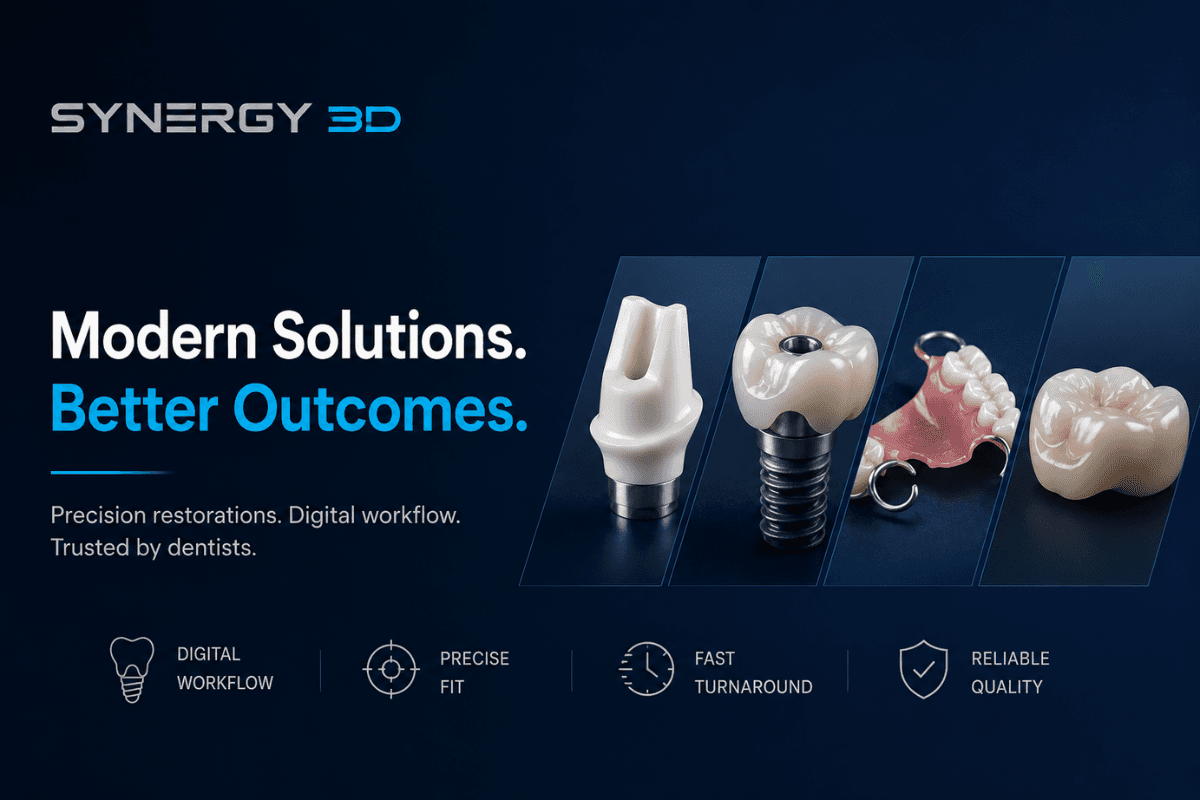
They need a laboratory with the technology, restorative knowledge, and production capabilities to handle different clinical situations. A practice may need a custom zirconia abutment for one case, a screwmentable crown for another, an acrylic partial denture for a removable patient, and porcelain fused to zirconia for a completely different restoration.
The ability to provide the right solution matters.
A Modern Lab Should Support Different Implant Needs
Implant dentistry is rarely one-size-fits-all.
The implant position, surrounding tissue, restorative space, and final crown design all influence the laboratory workflow. Therefore, the laboratory should be able to adapt its design to the individual case.
A custom zirconia abutment can provide greater control over the emergence profile and restorative contours. This can be especially valuable for anterior implant cases where the relationship between the restoration and surrounding tissue has a major effect on esthetics.
However, customization should be based on the clinical situation rather than material preference alone.
Retrievability Is Another Important Consideration
Implant restorations sometimes need to be accessed after delivery.
A screwmentable crown provides a retrievable approach by combining a custom abutment with a screw-retained crown. This can make future access more straightforward when maintenance or evaluation is required.
Synergy3D offers screwmentable restorations as part of its implant restoration solutions. The design provides a customized approach while maintaining screw-retained access.
For dentists, having this option available can be useful when developing a restorative plan around long-term maintenance.
Removable Dentistry Still Matters
Digital dentistry is often associated with implants, crowns, and CAD/CAM restorations. However, removable prosthetics remain an important part of everyday patient care.
An acrylic partial denture can help replace several missing teeth when a removable treatment is appropriate. Depending on the patient's needs, it can offer a practical solution without requiring an implant-supported restoration.
The laboratory still needs to pay close attention to tooth arrangement, fit, retention, occlusion, and appearance.
Synergy3D's restoration menu includes acrylic partial dentures alongside other removable solutions. This gives practices access to multiple options instead of limiting case planning to fixed restorations.
Strength and Esthetics Often Need to Work Together
Some restorative cases require a balance between durability and appearance.
Porcelain fused to zirconia is one option that addresses both considerations. The zirconia substructure provides the foundation, while the porcelain layer allows technicians to create more detailed esthetic characterization.
This can be useful when the restoration needs to maintain a natural appearance while also meeting functional demands.
Still, material selection should always consider the individual case. Location, occlusion, restorative space, and patient expectations all play a role.
Digital Technology Should Make the Workflow Easier
A laboratory cannot be considered truly useful simply because it owns CAD/CAM equipment.
The entire workflow matters.
Dentists should be able to submit digital scans easily, communicate case requirements clearly, and receive restorations that consistently meet the required specifications.
Synergy3D's digital workflow accepts scans from major intraoral scanner systems and allows practices to submit cases through its digital portal. The laboratory uses CAD/CAM design and in-house milling as part of its production process.
It reports a 4.2-day average turnaround, 99% fit accuracy, and a remake rate below 1%.
These capabilities are particularly valuable for practices that want to reduce unnecessary delays and maintain consistency across different types of cases.
Technician Expertise Still Matters
Digital technology improves the production process, but experienced technicians remain essential.
A software program can generate a design, but the technician must understand whether that design makes clinical sense. Implant contours, occlusion, anatomy, material selection, and esthetics all require human judgment.
Synergy3D combines digital design with certified technicians and in-house production. This approach allows the laboratory to maintain greater control over the restoration from digital design through manufacturing.
What Dentists Should Look for in a Laboratory
When evaluating a laboratory, dentists should consider whether it can provide:
- Digital case submission
- Major scanner compatibility
- Experienced technical support
- In-house manufacturing
- Implant restoration options
- Removable prosthetic solutions
- Multiple restorative materials
- Consistent quality control
- Reliable turnaround
Most importantly, the laboratory should have enough flexibility to handle different cases without sacrificing consistency.
One Practice, Many Restorative Needs
A dentist may submit a custom zirconia abutment case on Monday, a screwmentable crown on Tuesday, an acrylic partial denture later that week, and a porcelain fused to zirconia restoration the following day.
These cases may have very little in common clinically. Yet the laboratory should be capable of handling each one with the same attention to design, accuracy, and production quality.
That is where a comprehensive digital laboratory can make a meaningful difference.
The Takeaway
The best laboratory relationship is not built around a single product.
It is built around the ability to support the full range of restorative needs that a modern practice encounters.
From implant components and screw-retained restorations to removable prosthetics and esthetic ceramics, dentists benefit from having access to multiple solutions through a workflow designed around precision and consistency.
Before choosing your next laboratory partner, look beyond its most popular restoration. Ask whether it has the technology, expertise, and restorative range to support the cases you have not submitted yet.