When a dentist chooses e.max restorations , the material is only one part of the equation. The preparation, design, shade, occlusion, and laboratory workflow all influence the final result.
The interesting part about lithium disilicate is that it can deliver both excellent esthetics as well as the strength needed for many anterior and posterior applications. Clinical research has also shown strong longevity of lithium disilicate single-tooth restorations.
However, good material alone does not automatically mean a good restoration.
Start With the Clinical Situation
Each tooth has different requirements and hence different restorations.
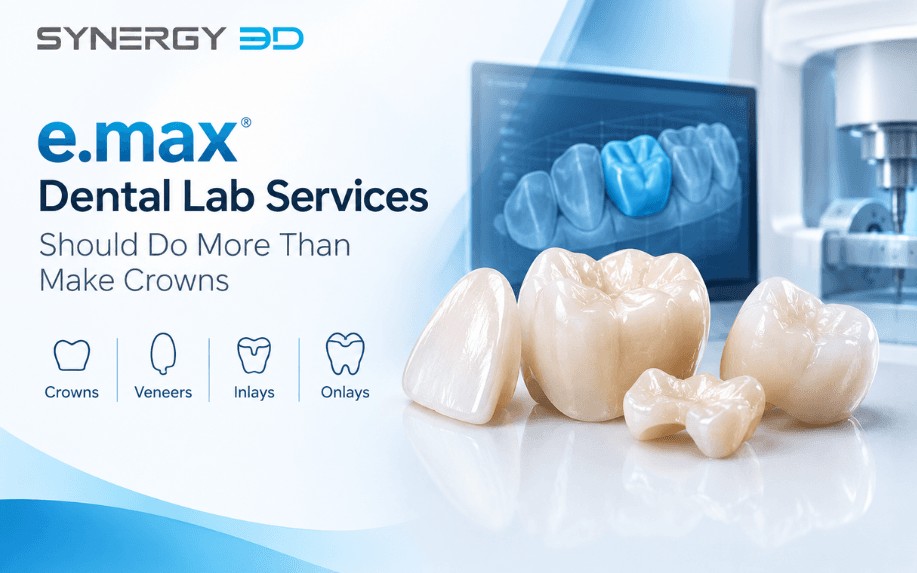
e.max can be used for crowns, veneers, inlays, and onlays. The ideal design depends on the amount of remaining tooth structure, location, occlusion, esthetic demands, and available space.
For example, anterior cases often place greater emphasis on translucency and shade. Posterior cases require careful attention to functional forces and restorative thickness.
This is why the laboratory needs more than a scan.
A complete prescription gives the technician the information needed to design around the dentist's clinical plan.
Preparation Still Sets the Foundation
A digital workflow cannot fix an inadequate preparation.
Smoother preparation surfaces with rounded internal angles, appropriate reduction, and a clear finish line act as a huge relief for the technician, since it gives them a better starting point.
The reason why the dentists should follow the material manufacturer’s advice for each specific case is because the exact preparation depends on the restoration and clinical situation.
However, there is one core principle which remains the most important: avoid unnecessary sharp angles.
Sharp internal features can create areas of concentrated stress. A smooth preparation gives the restoration a more predictable foundation.
The scan then needs to capture that preparation clearly.
The Scan Is Only as Good as the Information It Captures
Digital impressions have a huge impact on how dental practices communicate with laboratories.
A digital scan can transfer preparation details, occlusion, adjacent teeth, and soft-tissue information without shipping a physical impression.
Synergy3D is built around this digital workflow and supports major intraoral scanners, including iTero, 3Shape TRIOS, Medit, Carestream, Dexis, Sirona, Planmeca, and Align.
Still, the scan does not replace clinical information.
Photos, shade details, preparation notes, opposing scans, and clear instructions can all help the technician understand the case.
For demanding anterior e.max restorations , those details become especially valuable.
Shade Is More Than Picking a Color
One of the biggest advantages of e.max is its ability to reproduce natural-looking optical characteristics. But shade selection is not simply choosing A1, A2, or B1.
The underlying tooth, stump shade, restoration thickness, translucency, surface texture, and characterization can all affect the final appearance.
For example, Ivoclar's e.max Press system offers different levels of translucency and opacity for different cases. More translucent options work well for smaller restorations, while more opaque options can help cover darker tooth structures.
In short, the laboratory needs a clear understanding of what the dentist aims to achieve as the outcome, which is not limited to the shade.
Design and Occlusion Matter Just as Much
At the end of the day, an e.max restoration still needs to function like a tooth.
This means that the contacts should be appropriate; the occlusion needs to be considered; the anatomy should support function rather than simply reproduce a generic tooth shape.
This becomes particularly important in posterior cases.
Despite the research on lithium disilicate which states that restorations show strong long-term outcomes, the fear remains. Posterior teeth, particularly molars, can present greater functional demands.
The goal is therefore not simply to make the restoration beautiful.
It needs to be designed for the mouth it is going into.
What the Laboratory Brings to the Case
This is where the digital laboratory becomes more than a production facility.
At Synergy3D, e.max restorations are part of a digital workflow that combines CAD/CAM design, in-house milling, technician oversight, and quality control. The lab states that 98% of its restoratives are produced digitally.
This workflow keeps the case information connected from the practice to the final restoration. Additionally, it keeps the process consistent from scanning to design and production.
Synergy3D mills e.max restorations in-house in New York for both anterior and posterior cases.
Better e.max Cases Start Before the Lab Receives Them
The best e.max restorations are not created by material alone.
They start with an appropriate indication, a well-designed preparation, a complete scan, accurate shade information, and clear communication. The laboratory then turns those inputs into a restoration designed for the specific patient.
For dentists, that means the question should not simply be, “Can I use e.max?”
A better question is:
“Is this the right case for e.max, and does my laboratory have the workflow to execute it well?”
When both answers are yes, e.max becomes more than an esthetic material. It becomes a predictable part of a well-planned restorative workflow.
At Synergy3D, that workflow is built around digital case submission, CAD/CAM design, in-house production, and technician support. The result is a streamlined path from digital scan to finished restoration.