Dental implant restorations have advanced significantly beyond just replacing lost teeth. Currently, patients anticipate restorations that operate naturally, integrate effortlessly with surrounding teeth, and maintain stability for years ahead.
Reaching that result relies on each part of the restoration, including the implant abutment.
Although titanium has been the standard for a long time, the zirconia custom abutment is gaining popularity among clinicians who desire strength and exceptional aesthetics. The correct decision however, isn’t merely about choosing one material instead of another. It relies on the clinical scenario, restoration objectives, and the design and production of the abutment.
Why Material Selection Matters
An implant abutment links the implant fixture to the final restoration. Though seldom visible to patients, this element is crucial for supporting soft tissue, preserving emergence profiles, and guaranteeing lasting stability.
A custom abutment offers several benefits compared to stock parts as it is tailored to fit the patients’s unique anatomy. Rather than conforming the restoration to a typical shape, the abutmen is tailored to the restorative plan.
This leads to a more organic emergence profile, enhances tissue support, and provides clinicians with increased restorative options. The selected material for that custom abutment significantly impacts aesthetics, longevity, and overall clinical effectiveness.
Titanium vs. Zirconia: Understanding the Difference
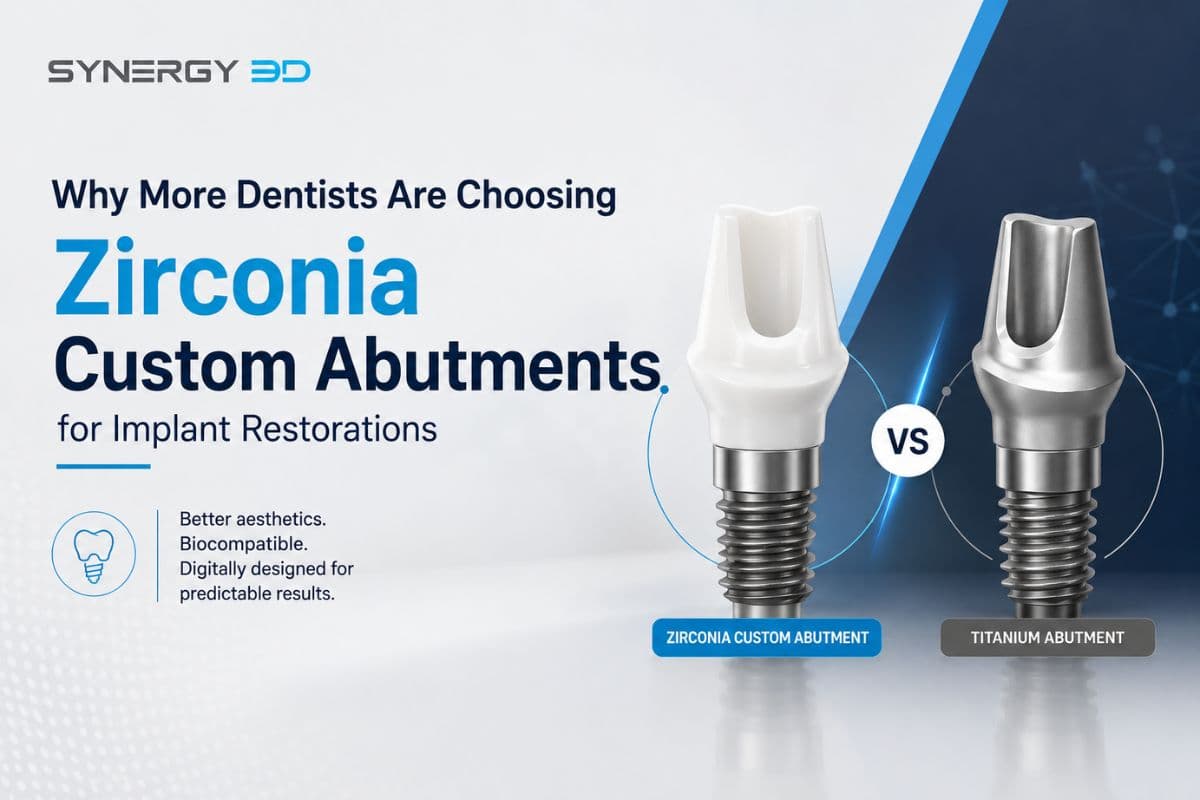
Titanium is still the material for any implants that go in the back of the mouth. This is because it is very strong and has been used for a time. Titanium works well in areas in areas where the teeth have to withstand a lot of force. It is a choice for complicated implant cases.
When it comes to implants that need to look good, a custom zirconia abutment is a better option. This is because it is the color of the teeth. So it does not cause a gray color to show through the gum tissue. This is especially important for implants in the front of the mouth where looks matter.
Many doctors do not think that titanium and zirconia are competing with each other. Instead, they choose one or another based on what the patient needs. The best results happen when the doctor picks the material that is right for the patient’s specific situation. This is better, than using the material for every patient.
Titanium and zirconia are good choices, but they are used in different situations. Doctors like to use titanium and zirconia because they want to give their patients the best results.
Where Zirconia Excels
The importance of aesthetics has surpassed that of function as patient expectations continue to rise.
A zirconia custom abutment gives ceramic restorations a more realistic appearance whil enabling physicians to design restorations that support soft tissue forms that appear natural.
Zirconia aids in the creation of highly aesthetically pleasing implant restorations that closely resemble natural dentition when paired with all-ceramic materials.
Because of its biocompatibility and ability to maintain healthy peri-implant tissue, it is a favored choice in many anterior situations where the appearance of the soft tissue greatly affects the outcome.
Digital Design Makes the Difference
Choosing the right material is only part of the equation. The design process has an equally significant impact on restorative success.
From margin placement and emergence profile to restorative space and tissue support, modern CAD/CAM workflows enable technicians to customise every element of the abutment. This degree of accuracy reduces needless chairside adjustments and results in restorations that fit more consistently.
Prominent digital labs are aware that accuracy cannot be guaranteed by software alone. Before production starts, every digital design still needs skilled specialists who can assess the clinical needs of each case.
Every implant case at Synergy3D adheres to a methodical digital workflow that blends cutting-edge CAD/CAM technology with skilled digital designers. Before being manufactured, every restoration is examined to make sure the finished product supports both function and aesthetics rather than just fulfilling production requirements.