This is the experience that every dentist has gone through.
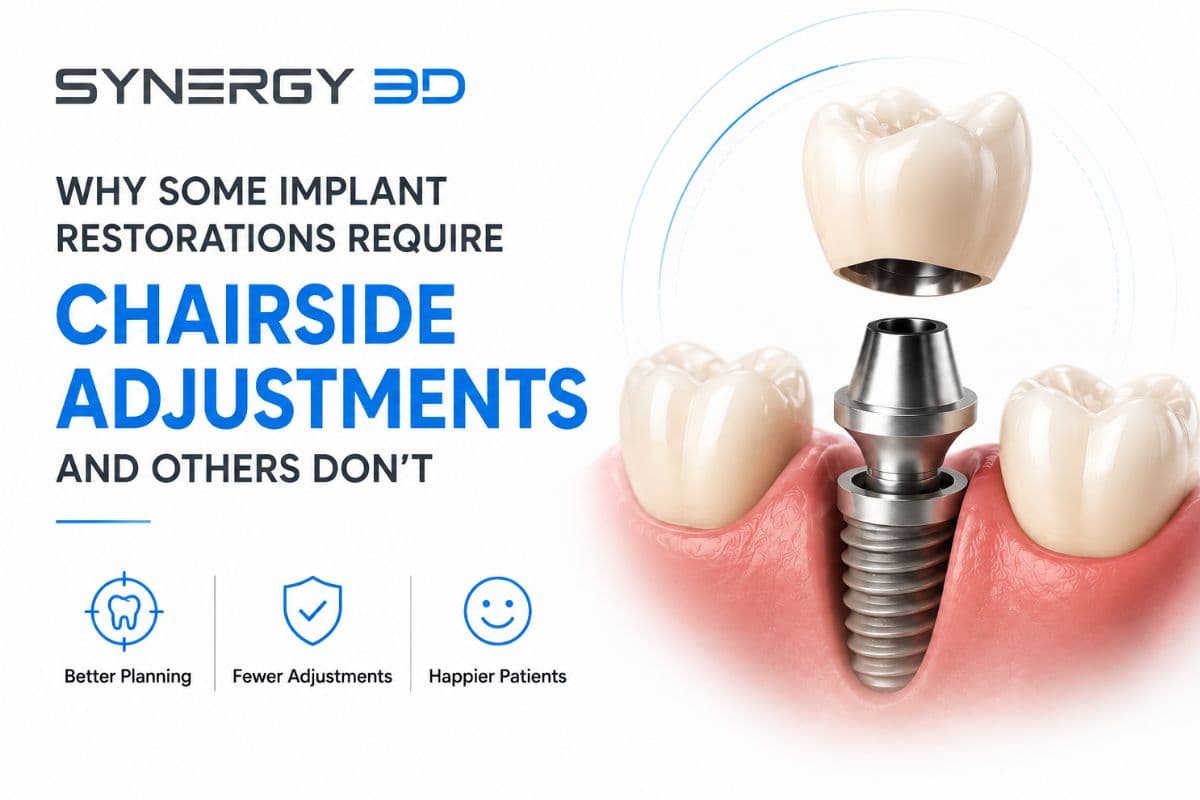
One hand one, one implant crown seats perfectly with little to no adjustment. But then the next case somehow requires occlusal corrections, contact adjustments, or additional chair time before it is ready for delivery.
Although each implant case is not the same, repeated chairside adjustments are rarely the result of a single factor. Instead, they are a byproduct of small issues that occur throughout the restorative workflow.
The key is to understand where these problems begin. This helps dentists reduce adjustments, improve efficiency, and achieve more predictable outcomes. More importantly, it highlights the value of working with an experienced implant dental laboratory.
It Starts Long Before the Restoration Is Made
There is a basic misconception. Many clinicians assume that the reason for adjustments is some mishap during the fabrication process. However, this is beyond the fabrication process.
The basis of a successful implant restoration is accurate information. Digital impressions, implant positions, bite records, soft tissue contours, and material selection all play a huge role in making the final decision.
Even the most minor inaccuracies during case submission can influence the way any restoration fits at a later stage.
Therefore, the core of successful implant restorations begins with complete and accurate clinical records.
Implant Position Matters More Than Many Realize
As you know, unlike natural teeth, implants cannot adapt to small positional differences.
Every implant case presents unique challenges. When dentists and laboratories review the case together at an early stage, they can identify potential issues before production begins and reduce the adjustments at a later stage.
Small Design Decisions Create Big Differences
Every implant restoration relies on careful planning. Details like contact points, occlusion, screw access, contours, and emergence profiles all affect the final fit.
When these elements are reviewed before production, restorations seat more predictably and require only a few adjustments.
What an experienced implant dental laboratory does is understand how to make all these factors work collectively instead of evaluating them individually.
Material Selection Influences the Final Fit
It is a fact that different restorative materials perform differently under clinical conditions.
For example, zirconia offers excellent strength for many implant restorations, while other materials may be better suited for specific esthetic situations.
Selecting the appropriate material depends on the location of the restoration, occlusal forces, patient expectations, and restorative goals.
Choosing the right material from the beginning helps support predictable long-term results.
Quality Checks Make the Difference
It is never appropriate to go straight from production to packing for a repair.
Prior to shipment, each restoration is thoroughly examined by top laboratories. Before the case gets to the practice, it is important to check the margin contacts, occlusion, screw access, anatomy, and general fit.
Consequently, a lot of possible problems are found before they become chairside modifications. Consistent laboratories are frequently distinguished from ordinary ones by this final quality review.
Why Communication Still Matters
It is an obvious fact that even the most advanced technology cannot replace clinical collaboration.
Examining restorative objectives, aesthetic standards, and implant placement reduces uncertainty and improves workflow. Similarly, prompt communication enables the laboratory and the dentist to address concerns before they have an impact on the final restoration.
Where Synergy3D Makes a Difference
At Synergy3D, every implant case follows a carefully planned digital workflow supported by experienced technicians and multiple quality checkpoints.
Rather than just producing restorations, the team carefully examines every case. They concentrate on minimizing the modifications that cause delays in visits and negatively impact the patient's experience.
This method supports effective, self-assured delivery while assisting practices in receiving restorations that fit more consistently.
The Bottom Line
It's not always possible to avoid chairside modifications. However, many can be decreased with careful planning, precise documentation, careful design, and regular quality control.
The right implant dental laboratory contributes at every stage of the restorative process, long before the restoration reaches your operatory.
Appointments run more smoothly; restorations are more predictable, and patients have a better overall experience when each workflow stage receives proper attention.