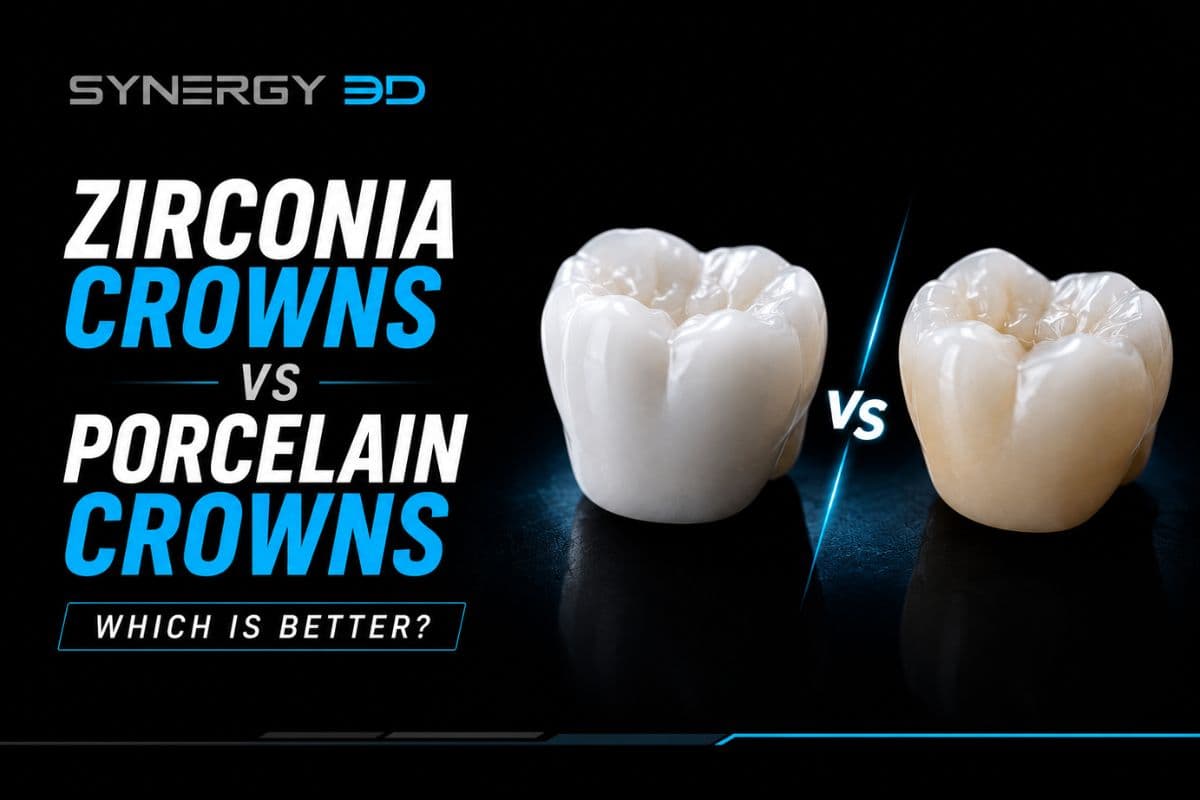
The selection of material still continues to be one of the most crucial decisions to make when we talk about restorative dentistry.
While both porcelain and zirconia crowns have shown proven clinical success, each material offers distinct features depending on the requirements of the case.
Rather than comparing the two of them, the dentists should have a clearer understanding of which material is suited best, given the requirements and priorities of the patients.
Let us first list down the specifications of each type of crown against relevant parameters. This will help the clinicians get a better idea of the features and when should either be utilised.
Zirconia vs Porcelain: Key Clinical Differences
|
Clinical Parameter |
Porcelain Crowns |
Zirconia Crowns |
|
Aesthetics |
Superior translucency and enamel-like optical properties |
Improved aesthetics but generally less translucent |
|
Flexural Strength |
400–500 MPa |
1000–1200 MPa |
|
Fracture Resistance |
Good |
Excellent |
|
Tooth Reduction |
May require greater reduction for optimal aesthetics |
Often allows more conservative preparations |
|
Biocompatibility |
Excellent |
Excellent |
|
Stain Resistance |
High |
Very High |
|
5-Year Survival Rate |
Approximately 90–95% |
Approximately 97–99% |
|
Best Indications |
Anterior aesthetic cases |
Posterior restorations, bruxism cases, implant restorations |
Now, let’s discuss this in detail.
Aesthetic Performance
It is clearly obvious that if a patient wishes to opt for highly aesthetic anterior restorations, porcelain continues to be a preferred material. The reason being -
- Superior translucency;
- Ability to replicate the optical characteristics of natural enamel;
- Excellent shade matching, incisal characterization, and light transmission, making them particularly suitable for patients with focus on aesthetics.
Although zirconia materials have significantly improved their aesthetics, porcelain still maintains an advantage in such cases.
Strength and Longevity
When functional performance is a priority, zirconia crowns offer clear advantages.
For clinicians seeking long-term predictability in heavy environments, zirconia often becomes the material of choice.
Tooth Preservation and Preparation Design
As restorative dentistry aims to achieve minimal invasive treatments, it is important to make sure that the preparation is top notch.
Porcelain restorations may require a bit of more space to fit in the crown. This means that the natural tooth may have to be chipped off, hence utilising more material thickness to achieve the desired aesthetic outcomes.
Hence, for clinicians prioritizing tooth preservation, zirconia may offer a distinct advantage.
Clinical Indications
So, basically, we can confidently say that the choice between zirconia and porcelain should ultimately be guided by case-specific requirements.
Zirconia may be preferred for:
- Posterior crowns and bridges
- Bruxism and clenching patients
- Implant-supported restorations
- Full-mouth rehabilitation cases
- Situations requiring maximum fracture resistance
- Cases with limited occlusal clearance
Porcelain may be preferred for:
- Anterior aesthetic restorations
- Smile design and cosmetic cases
- High smile line patients
- Cases requiring advanced shade matching
- Situations where optical properties are the primary concern
Beyond Material Selection: The Importance of Laboratory Precision
While material obviously plays a very big role in the success of restorative procedures, laboratory execution remains equally important.
Now with advancements in CAD/CAM technology, predictability across both zirconia and porcelain restorations have been improvised. This helps the labs to produce results that are more accurate and consistent.
This is where Synergy3D differentiates itself.
As a digital-first dental laboratory, Synergy3D built its workflow around CAD/CAM technology from the beginning, with over 98% of restorations produced digitally. By integrating intraoral scans, digital design protocols, precision milling, and standardized quality control, the lab helps clinicians achieve greater consistency across both zirconia and porcelain cases.
For zirconia crowns, this translates into accurate margins, reliable contacts, and restorations designed to withstand high functional loads. For porcelain and layered restorations, the same digital workflow supports precise framework design and aesthetic predictability, reducing remakes and adjustment time.
Beyond fabrication, Synergy3D partners with dental practices to streamline digital case submission, accelerate turnaround times, and improve restorative outcomes through a fully integrated workflow. The result is simple: fewer surprises, greater clinical confidence, and restorations that perform as expected from insertion to long-term follow-up.
Conclusion
To conclude, the best restorations are not simply strong or aesthetic. They are predictable.
Whether you choose zirconia crowns for its durability or porcelain for its optical superiority, long-term success depends on selecting the right material, for the right case, supported by the right laboratory partner.
At Synergy3D, our focus is simple: helping clinicians reduce uncertainty, improve restorative outcomes, and deliver results their patients can trust.
FAQs
-
Are zirconia crowns stronger than porcelain crowns?
Yes. Zirconia crowns offer significantly higher flexural strength and fracture resistance, making them ideal for high-bite-force areas.
-
Which crown looks more natural: zirconia or porcelain?
Porcelain crowns generally provide better translucency and enamel-like aesthetics, making them a preferred choice for front teeth.
-
Are zirconia crowns suitable for anterior teeth?
Yes. Modern zirconia materials offer improved aesthetics, but porcelain often remains the preferred option for highly aesthetic anterior restorations.
-
Which crown material lasts longer?
Zirconia crowns typically have higher long-term durability and survival rates due to their exceptional strength and wear resistance.
-
How do dentists choose between zirconia and porcelain crowns?
The choice depends on factors such as tooth location, aesthetic requirements, bite forces, available space, and the patient's functional needs.