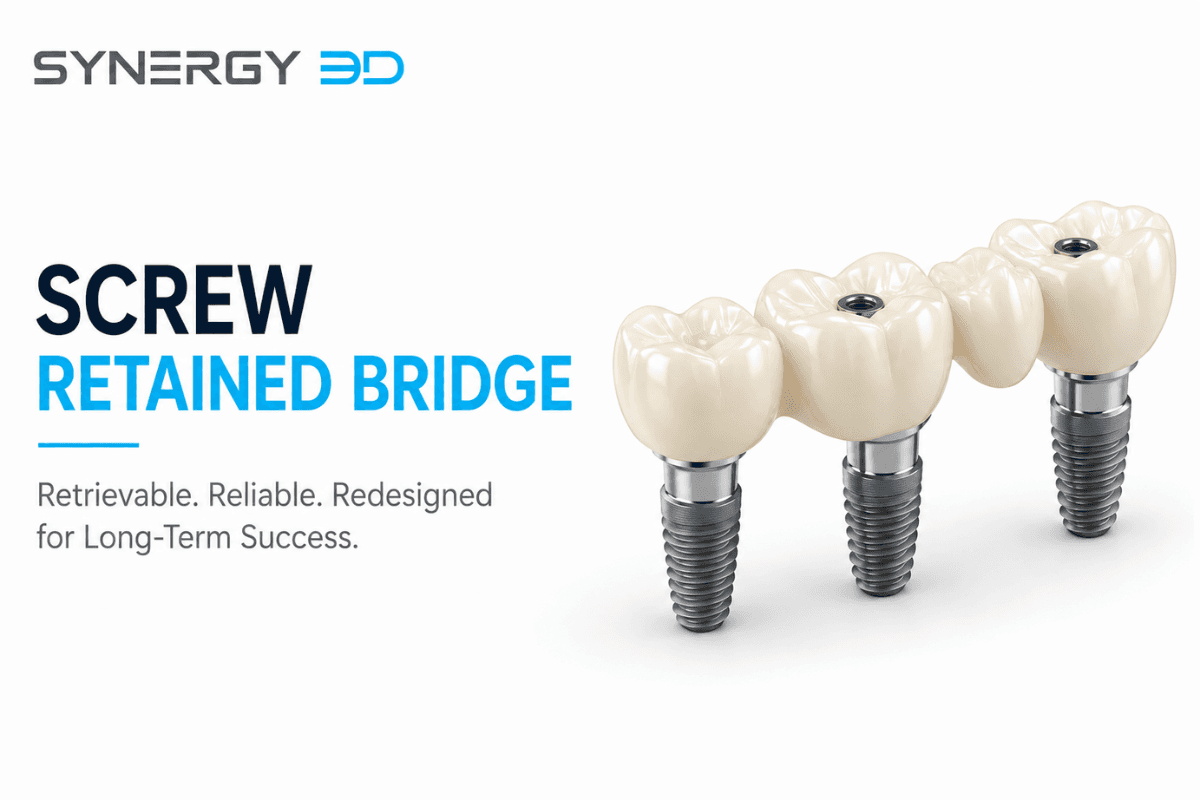
Implant-supported bridges allow the dentists to replace multiple missing teeth while simultaneously maintaining a fixed restoration. Among the available options, a screw retained bridge stands out because in case of access for maintenance or future treatment, the restoration can be removed.
However, making the choice is the first step. Implant position, restorative space, occlusion, material, framework design, and laboratory precision all influence the final result. Understanding these factors can help dentists plan cases more effectively and choose a laboratory capable of executing the design accurately.
What Is a Screw Retained Bridge?
A screw retained bridge is an implant-supported restoration that can be locked directly to the implants by making use of prosthetic screws.
But in case of a cement-retained restoration, there is no need to cement the bridge onto separate abutments. This creates a retrievable restoration that can be removed when necessary.
Retrievability can act as an advantage in case of implant-supported cases because access may be needed for hygiene, component inspection, repair, or future maintenance.
Why Retrievability Matters
Implant restorations are made to last, but they also need to be easy to maintain over time.
In case of screw-retained restoration , it can be easily removed in case of any future maintenance, hence making the process more sorted and smoother.
Additionally, it also avoids concerns about excess cement around the implant. However, the position of the screw access hole still needs to be considered, as implant angulation can affect where it happens.
Design Can Make or Break the Result
A bridge is not simply a larger version of a single implant crown.
Multiple implants introduce additional variables and through digital design, it can help manage those multiple variables more consistently.
At Synergy3D, screw retained bridges are digitally designed and milled in-house as part of the laboratory's implant restoration workflow. The laboratory also offers full-arch zirconia bridges, PMMA bridges, and other implant solutions depending on the clinical requirements of the case.
Material Selection Still Matters
Not every screw-retained bridge needs to be made from the same material.
It should be according to the requirement of the restorative solution.
For eg. Zirconia works where strength and esthetics are important. Similarly, in case of a lighter or flexible restorative solution is required, screw-retained PMMA bridges can work wonders.
As for Synergy3D , it offers screw-retained zirconia bridges which are full-arch restorations designed to combine strength with aesthetics. Additionally screw-retained PMMA bridges in case of flexible restoration solutions.
Digital Precision Helps Reduce Variables
The accuracy of an implant bridge depends heavily on how the case is captured, designed, and manufactured.
Digital scans help provide detailed information about the implant positions and surrounding structures.
CAD/CAM software then allows technicians to design the restoration around that information before it is milled.
Synergy3D was established as a digital-first laboratory and reports that 98% of its restorative work is produced digitally. Its workflow combines certified technicians, CAD design, and in-house milling, with the laboratory reporting sub-30µm precision and a remake rate below 1%.
For implant bridges, this level of control can be especially valuable because several components must work together within the same restoration.
The Laboratory's Role Goes Beyond Manufacturing
A digital file does not automatically produce a predictable bridge.
Experienced technicians have such a important role to play where they need to evaluate the design and understand how implant position, occlusion, material, and restorative anatomy interact.
Synergy3D's implantology team includes dedicated CAD/CAM and implant specialists. This is exactly the combination that helps dentists address potential design concerns before the bridge reaches the practice.
When Should Dentists Consider a Screw Retained Bridge?
A screw retained bridge may be worth considering when:
- Multiple implants are supporting a fixed restoration
- Retrievability is important for long-term maintenance
- Implant angulation allows suitable screw access
- The case requires a digitally designed multi-unit restoration
- The clinician wants to avoid cement-related concerns
- The restorative plan benefits from a fixed implant-supported solution
Each case still needs individual evaluation. Implant position, bone and tissue conditions, occlusion, available space, and patient expectations should guide the final design.
The Takeaway
A screw retained bridge offers more than a different way to attach an implant restoration. Its retrievability, design flexibility, and digitally controlled fabrication can make it a valuable option for carefully selected cases.
The key is to look beyond the retention method itself. A predictable bridge depends on accurate digital records, thoughtful design, appropriate materials, and precise manufacturing.
At Synergy3D, those elements come together through a digital workflow, in-house milling, experienced technicians, and a dedicated range of implant-supported solutions.
Before your next multi-implant case, evaluate the implant positions, screw access, material requirements, and final restoration together. The better the plan before production, the more predictable the bridge can be at delivery.