Patients only see the crown and rarely think about what sits underneath it.
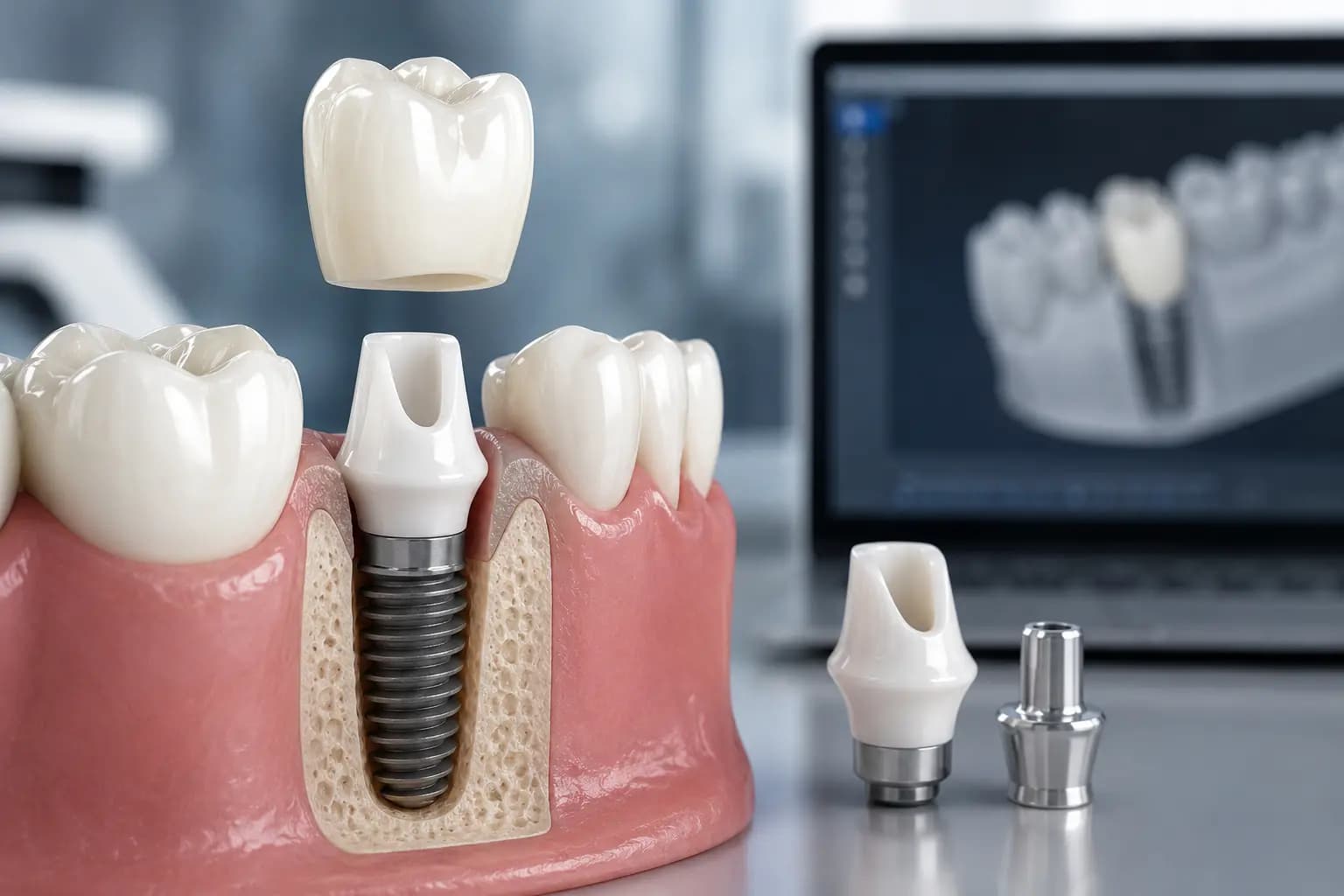
Yet the components used in the implant restoration can have a major influence on its final appearance, fit, and function. Among them, the zirconia custom abutment can play an important role in cases where the priority is esthetics and precise restorative design.
The interesting part is that the abutment itself may never be visible. However, its design can influence what patients ultimately see.
The Abutment Is More Than a Connector
The implant and the final restoration are joined by an implant abutment. But it does more than just connect two parts.
The emergence profile, tissue support, restorative space, and final crown contour can all be impacted by its position and shape. Therefore, rather than being handled as a stand-alone part, the abutment must be integrated into the restorative strategy as a whole.
Custom abutments can be useful for this purpose. The laboratory can construct the abutment around the particular needs of the case rather than modifying the repair around a standard component.
Why Zirconia Can Make a Difference
Anterior implant cases leave little room for visual compromises.
When gingival tissue is thin or translucent, the appearance of the underlying abutment can impact the final esthetic result. Zirconia offers a tooth-colored alternative that can help create a more natural transition beneath an all-ceramic restoration.
However, material alone is not the deciding factor.
A well-designed zirconia custom abutment still needs to support the intended emergence profile, tissue contours, and final crown design.
If you're comparing zirconia and titanium for different implant situations, our previous guide on zirconia custom abutments and titanium provides a closer look at the material considerations.
Customization Changes the Restorative Equation
Conditions vary depending on the implant situation.
The thickness of tissue varies. There are different types of restorative spaces. Teeth next to each other differ. The patient's aesthetic expectations also change.
In certain circumstances, a stock abutment might be effective, but the laboratory has more control over these factors with a custom design. The unique case can be taken into consideration while planning the emergence profile, contours, margin location, and restorative space.
As a result, the finished crown has a stronger basis for attaining the intended shape and purpose.
The Real Advantage Is in the Design
Choosing zirconia does not equal better restoration. The design and manufacturing process are equally important.
Modern CAD/CAM workflows allow technicians to control the details of an abutment with far greater precision. However, software cannot replace clinical judgment. The technician still needs to understand how the design will affect tissue, occlusion, esthetics, and the final restoration.
At Synergy3D, implant cases are developed through a digital workflow supported by experienced technicians and digital designers. The laboratory offers Zirconia Hybrid Custom Abutments that combine zirconia aesthetics with a titanium base for the implant connection.
When the Abutment and Crown Work Together
The abutment should not be designed separately from the restoration that sits on top of it.
When both are considered together, the laboratory has more authority over the relationship between the implant, soft tissue, abutment, and final crown. This can be particularly important in highly visible anterior cases.
Synergy3D also offers zirconia screw-retained crowns on titanium bases, combining zirconia aesthetics with a stable titanium interface and retrievable screw-retained construction.
That broader restorative approach allows the material and design to be selected according to the needs of the case rather than forcing every patient into the same solution.
Where Synergy3D Adds Value
A digital workflow is only useful when it produces consistent results.
Synergy3D reports sub-30µm precision, a remake rate below 1%, and an average turnaround of 4.2 days. Its restorations are milled in-house, while experienced technicians oversee the digital design and production process. (Synergy 3D)
The laboratory also reports that 98% of its restorative work is produced digitally. This allows digital design, manufacturing, and quality control to work together throughout the case. (Synergy 3D)
For dentists, that means the value of a zirconia custom abutment is not simply the material. It is the precision behind how that material is designed and produced.
Look Beyond the Crown
The next time you evaluate an implant restoration, look beyond the part the patient sees.
Consider the tissue. Consider the emergence profile. Consider the restorative space. Most importantly, consider whether the abutment and final restoration have been designed as one complete solution.
A zirconia custom abutment may be hidden beneath the final crown, but the decisions made around it can influence the restoration patients see every day.
Before your next implant case, ask not only which abutment material is appropriate, but how the abutment design will support the final restoration.